
Fast, Reliable Attic Insulation Across Glendale
Attic insulation in Glendale is rarely a simple top-up job, and if your home was built between 1920 and 1960, chances are the attic is either barely insulated or packed with material that gave up years ago. We’re Porch Light Insulation, and Attic Insulation is the only trade we work in. That focus matters in Glendale, because the housing stock here has quirks: shallow eave bays on steep Verdugo foothills slopes, plaster-and-lath ceilings, and WUI fire zones above Chevy Chase and Adams Hill where the wrong batt job will not pass inspection. We handle blown-in, batts, spray foam, removal, and mold remediation, and we’ll tell you honestly which approach fits your specific attic rather than whatever is sitting in our warehouse. Call (877) 521-4987 and we’ll have someone out to Glendale fast, usually within one business day.
Why Porch Light Insulation Is Glendale’s Preferred Attic Insulation Company
We carry an eight-brand product bench – Owens Corning, Johns Manville, Knauf, Rockwool, CertainTeed, Icynene, Demilec, and GreenFiber – because no single material works for every attic in this city. A flat 1940s tract home off Glenoaks has different requirements than a 1927 hillside Spanish in Verdugo Woodlands, and we match the material to your home, not to our inventory. Every estimator and installer here is insulation-only: we don’t split attention across roofing, HVAC, or remodeling side work. That means when we look at an attic in Glendale, we’re only thinking about thermal performance, air sealing, moisture, and fire-rated detailing. Gil Tanner, who runs Porch Light, has spent his career drilling into the specific ways older Southern California homes fail thermally. That’s why our Glendale customers tend to call us back when they add a room or renovate.
Attic Mold Removal in Glendale
Attic Mold Removal in Glendale usually means something very specific: a hillside home with blocked soffit vents, where warm moist air from the living space has been condensing against the underside of the roof sheathing for years. We see this pattern constantly in Chevy Chase and Verdugo Woodlands. Homes on these steep, shaded canyon floors stay cooler and wetter than the exposed ridgelines, and if the attic was insulated decades ago with collapsed batts or loose-fill jammed into the eave bays, the soffit pathway chokes and humidity just sits there. Mold follows. When we remove moldy or degraded insulation in a Glendale attic, we remove the source of the moisture problem at the same time – otherwise spores return. We bag and haul the contaminated material, treat the affected framing, and re-establish ventilation with ember-resistant vents where the WUI line applies. Expect this work in Glendale to run $2,800 – $6,500 depending on attic square footage, contamination spread, and whether partial or full removal is needed. Sometimes it’s a contained 200-square-foot eave bay. Sometimes the entire attic has to go.
Our Mold and Moisture Approach
We don’t just spray and walk away. Before new insulation goes in, we identify why the moisture accumulated in the first place. In many 1920s – 1950s Glendale homes, the issue is original single-pane wood windows and no bathroom exhaust fans – moisture migrates upward through gaps around knob-and-tube penetrations and condenses in the cold attic. We seal those bypasses as part of the job. Without that step, you’re paying for a temporary fix. We also check roof leaks and plumbing vent stacks before we treat anything. If there’s an active water source, insulation replacement alone will not solve the mold problem.
What to Expect on the Job
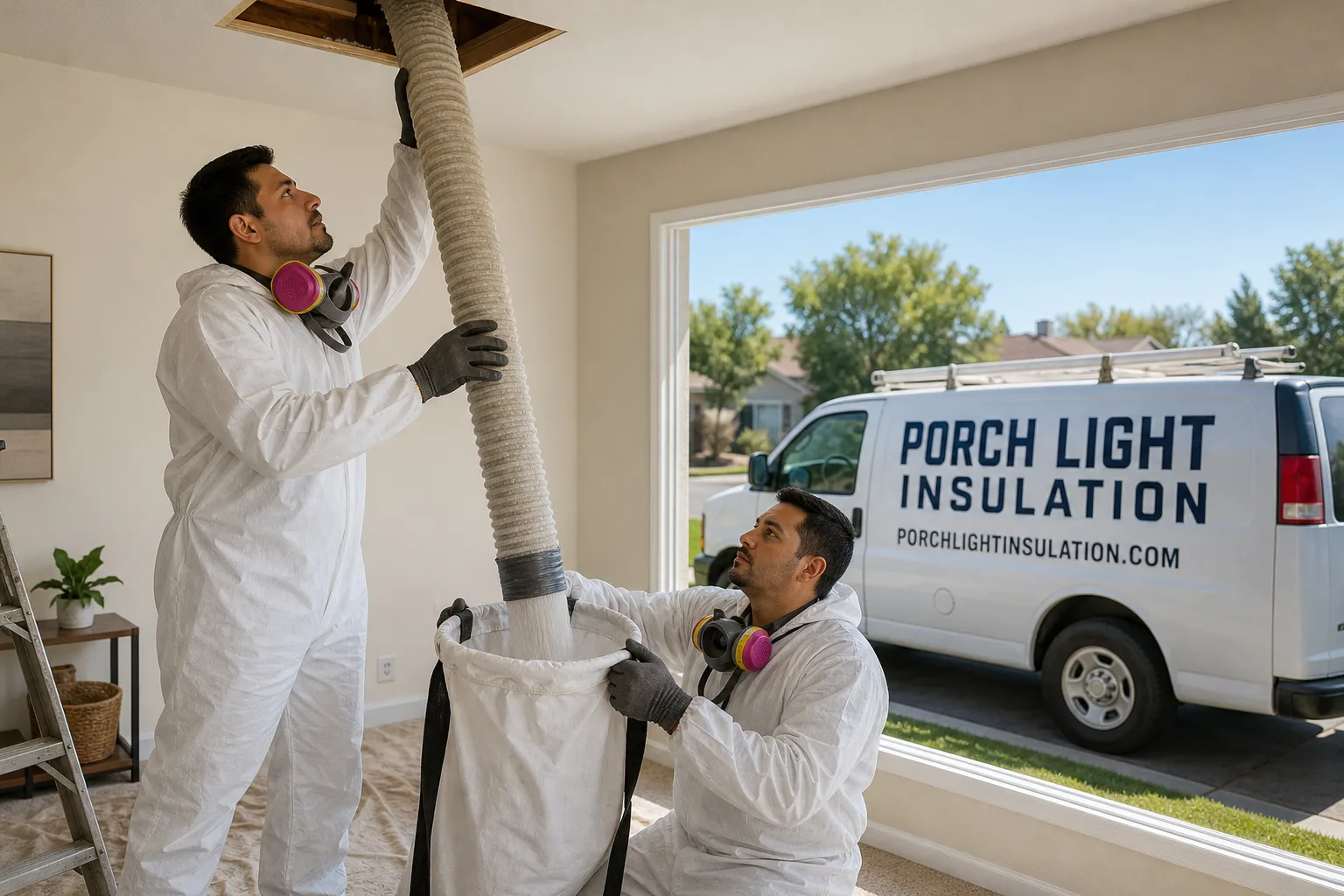
A typical Glendale mold removal and insulation replacement takes one to two days. We protect your living space with negative air containment when contamination is extensive. The old material goes out through the attic access or gable end, never through your living room. Then we treat the framing and sheathing with an EPA-registered antimicrobial, re-establish airflow, and install fresh insulation matched to the specific attic geometry and WUI requirements of your street.
Attic Insulation Removal in Glendale
Attic Insulation Removal in Glendale is required more often here than in neighboring Burbank or Pasadena, and the reason comes down to building age and materials. Many of the homes in this city still carry their original insulation – 1940s and 1950s mineral wool or fiberglass batts that have collapsed, compressed, or been shredded by rodents over decades. That degraded material doesn’t just underperform; it blocks the soffit ventilation pathway, which overheats the whole attic. In some cases it’s fire-damaged. In others it’s been soaked by a roof leak. In still others, a homeowner bought a place and the old insulation is so thin you can see the ceiling joists. Full removal in Glendale typically runs $1,500 – $4,200, while a partial removal focused on contaminated or collapsed sections runs $700 – $1,800. We give you a hard number after an attic walk-through, not a vague range over the phone.
When Removal Beats Topping Up
If the existing material has mold, pest droppings, heavy dust, or water damage, adding new insulation on top locks the problem in place. If the soffit vents are completely blocked by compressed old batts, adding more insulation compounds the ventilation failure. We’ll tell you straight: some Glendale attics only need a top-up, and we don’t push removal where it isn’t necessary. But when the material is compromised, removal and fresh installation is the only repair that actually holds. We also remove old insulation before air sealing in many older homes, because sealing around decades of embedded dust and debris produces poor results.
Debris, Rodent, and Soot Concerns
Rodent contamination is common in Glendale’s older homes, especially where raised foundations connect the crawlspace to the attic through wall cavities. Soot from old knob-and-tube overheating or a past chimney issue is another removal trigger. Both situations call for full extraction, sanitization, and fresh installation with appropriate sealing. We handle all of it as an insulation contractor – not a restoration company that will sub the insulation out.
Trusted Brands We Service in Glendale
Because we install across eight manufacturers rather than being locked into one, we’re not steering every Glendale homeowner toward the highest-margin material. For a tight-budget attic in a 1950s ranch off Pacific Avenue, GreenFiber blown-in cellulose often makes the most sense at around R-38. For a hillside WUI home above Adams Hill that needs fire-rated facing, we’ll spec Rockwool with a foil or painted fire-rated vapor barrier. For homes needing air sealing plus insulation in a single pass, a closed-cell Demilec spray foam is hard to beat, though it isn’t cheap. Owens Corning and Johns Manville batts fill the middle of the market well. The point is simple: eight manufacturers, one goal: the right fit for your specific situation. Stock and delivery times to Glendale are short because we work directly with regional distributors.
Common Attic Insulation Problems We See in Glendale Homes
- Collapsed legacy batt and mineral wool jammed into shallow eave bays. On steep-slope Verdugo foothills lots, the attic narrows to almost no depth at the eaves, and old insulation has slumped into that gap. The result: blocked soffit ventilation, trapped heat, and an attic that runs 140°F+ through August.
- WUI inspection failures in Chevy Chase and Adams Hill. A standard big-box batt job with ordinary vents will not pass inspection in Glendale’s fire-rated hillside zones. You need fire-rated facings and ember-resistant vents. Burbank contractors frequently miss this detail because Burbank’s flat tracts don’t require it.
- Air leakage through plaster-and-lath ceilings. 1920s – 1950s homes weren’t air sealed at the top plate, and old knob-and-tube penetrations leave open paths from living space into the attic. Dust, heat, and allergens migrate freely. Sealing these bypasses is the first step in any retrofit we do.
- Original single-pane windows driving heat upward. A 1920s Glendale home with original wood windows loses and gains heat at the glazing, but the attic takes the brunt of the stack effect. We often find the top plate is hot to the touch in summer. Insulation helps, but only when combined with air sealing and proper venting.
Pricing for Attic Insulation in Glendale, CA
For a standard 1,200 – 1,500-square-foot attic in a 1920s – 1950s Glendale home, a full removal and R-38 blown-in cellulose installation typically runs $4,200 – $7,800. A top-up over existing insulation runs $1,800 – $3,400, depending on current depth and condition. New batt installation in an accessible attic runs $2,500 – $5,000, while closed-cell spray foam in a Glendale attic runs $8,500 – $15,000+ for the same square footage. WUI-specific work – fire-rated facings, ember-resistant vents, mineral wool – adds $800 – $2,200 on top of the base job. Steep-slope attics with restricted access and low clearance push labor higher. Every quote is free, and Gil Tanner reviews every Glendale proposal before it goes out. Call (877) 521-4987 for an exact number on your attic.
We Also Serve Cities Near Glendale
Beyond Glendale, our trucks run regularly to Burbank, La Cañada Flintridge, Echo Park, and Silver Lake. Burbank’s flat tracts and stucco boxes are a different animal from Glendale’s hillside stock, but we carry the same fire-rated materials and mineral wool for WUI work in both. If you’re in one of these neighboring communities and need an insulation specialist rather than a general contractor, call (877) 521-4987.
Serving Glendale, CA — Our Local Coverage Area
We’re based in the Glendale area and know this community well. Use the map below to see our service coverage — if you’re nearby, we can almost certainly help.
FAQs About Attic Insulation in Glendale
No. In the WUI zones above Chevy Chase and Adams Hill, a standard batt job with ordinary vents will fail inspection. Glendale requires fire-rated facings and ember-resistant venting in these areas, and a Burbank contractor’s spec sheet typically doesn’t account for that. We build these details into every hillside quote. Call (877) 521-4987 and we’ll verify your exact WUI classification.
Yes, it changes the air-sealing stage significantly. Plaster-and-lath ceilings have hundreds of small gaps at wall intersections, light fixtures, and original knob-and-tube penetrations. If you insulate without sealing these, the attic stays dusty and hot air keeps migrating upward. We treat older plaster homes with a full top-plate air-sealing pass before any insulation goes in. The work takes longer but the comfort difference is immediate.
Steep-slope construction on those hillside lots means the roofline drops quickly toward the eaves, leaving almost no usable attic depth near the edges. This isn’t a defect – it’s the geometry of the build. But it does limit what you can do. We often combine low-clearance blown-in work with rafter-vent installation to keep airflow moving through the tight eave bays. Some of the shallowest attics we’ve ever worked in are in Verdugo Woodlands.
Yes. A home on an exposed Verdugo ridgeline gets hammered by full sunlight and radiates heat downward all day, while a shaded canyon-floor home below may stay 20 degrees cooler. We spec differently for each. Exposed ridgelines benefit from radiant barrier under the roof deck plus higher R-values, while canyon floors need more attention to moisture and ventilation than raw thermal resistance. No citywide spec works here.
We remove when the existing material is moldy, rodent-contaminated, water-damaged, or so collapsed it’s blocking the soffit vents. In Glendale’s 1920s – 1950s homes, this describes a large share of attics we walk into. Adding fresh insulation over compromised material locks the problem in and often makes ventilation worse. Removal and reinstallation costs more up front, but it’s the only fix that lasts. Call (877) 521-4987 for a free attic assessment and exact pricing.
Written by Gil Tanner, Owner at Porch Light Insulation, serving Glendale and the surrounding communities as an insulation-only contractor.