
Fast, Reliable Attic Insulation Across Shadow Hills
Attic insulation in Shadow Hills usually runs $2,800 to $7,500 for a full removal-and-reinstall on a ranch home or custom build, and we can typically start within three to five business days. For a smaller top-up or detached garage, expect $900 to $2,200. Porch Light Insulation has worked across 91040 for years, and we know what 100-degree canyon afternoons do to an uninsulated attic — which is why we also offer Reflectix repair in Shadow Hills for homes needing radiant barrier solutions. If your upstairs bedrooms won’t hold temperature or your energy bill climbs every July, call Gil Tanner’s team directly at (877) 521-4987 and we’ll come measure, inspect, and give you a straight answer.
Why Porch Light Insulation Is Shadow Hills’s Preferred Attic Insulation Company
Insulation is all we do, which means it’s all we’ve mastered. Porch Light isn’t a general contractor squeezing attic work between roofing jobs. Every estimator, installer, and product recommendation we make is built around one trade: Attic Insulation. For Shadow Hills homeowners, that focus matters because your homes aren’t tract houses. They’re custom mid-century ranches, horse properties, and additions built at different times with different framing and different failure points. A specialist recognizes what a generalist walks past.
We carry eight manufacturers on our bench, including Owens Corning, Johns Manville, GreenFiber, and Demilec. That means when we quote a job in Shadow Hills, we’re matching material to your attic conditions, not pushing whatever’s sitting in the warehouse. Mineral wool for fire-conscious brush-adjacent lots. Cellulose for an older ranch with deep bays and odd framing. Closed-cell spray foam for a cathedral ceiling over the living room. You don’t have to figure out which product solves the problem. We compare options so you don’t have to guess.
Response time to Shadow Hills is something we take seriously. We’re based in Universal City and run crews up the 5 and across Sunland Boulevard regularly. If you call on a Monday, we can usually have someone standing in your attic by Thursday. And because we work in the canyon routinely, we already know the roads, the parking constraints on long driveways, and the horse-trailer realities of Schulman Grove and La Tuna Canyon Road. You won’t spend time explaining your street. We know it.
Attic Mold Removal in Shadow Hills
Attic Mold Removal in Shadow Hills is a specialized job, and it starts with finding out why the mold grew. In a canyon climate with cool nights and hot days, condensation forms on the underside of roof sheathing when an attic isn’t venting properly. Add dust from horse paddocks and dry brush, and that moisture sticks around. We don’t just spray and walk away. We identify the air-sealing and ventilation failure, remove the affected insulation, treat the framing, and re-insulate in a way that stops the moisture from returning.
A typical attic mold removal in Shadow Hills costs between $1,800 and $4,500 depending on square footage and how much of the existing Attic Insulation in Shadow Hills has to come out. Smaller spot treatments can run under $1,200. Crew time is usually one to two days, and we use containment to keep spores from drifting into the living space or, just as important, into a barn or tack room attached to the house.
Mold Removal Without Gutting the Attic
Many homeowners worry mold removal means tearing the house apart. It doesn’t. In most cases we remove the affected insulation, clean and treat joists and sheathing, then install new material. For ranch homes with tongue-and-groove ceilings, we work from the attic side so nothing below gets touched.
Mold Around Chimney Chases and Bath Fans
In Shadow Hills, we often find mold concentrated where bath fans vent into the attic instead of through the roof. That’s a code miss from decades ago. We correct the vent path, seal the penetration, and only then re-insulate. Fixing the source is the only way the problem stays gone.
Attic Insulation Removal in Shadow Hills
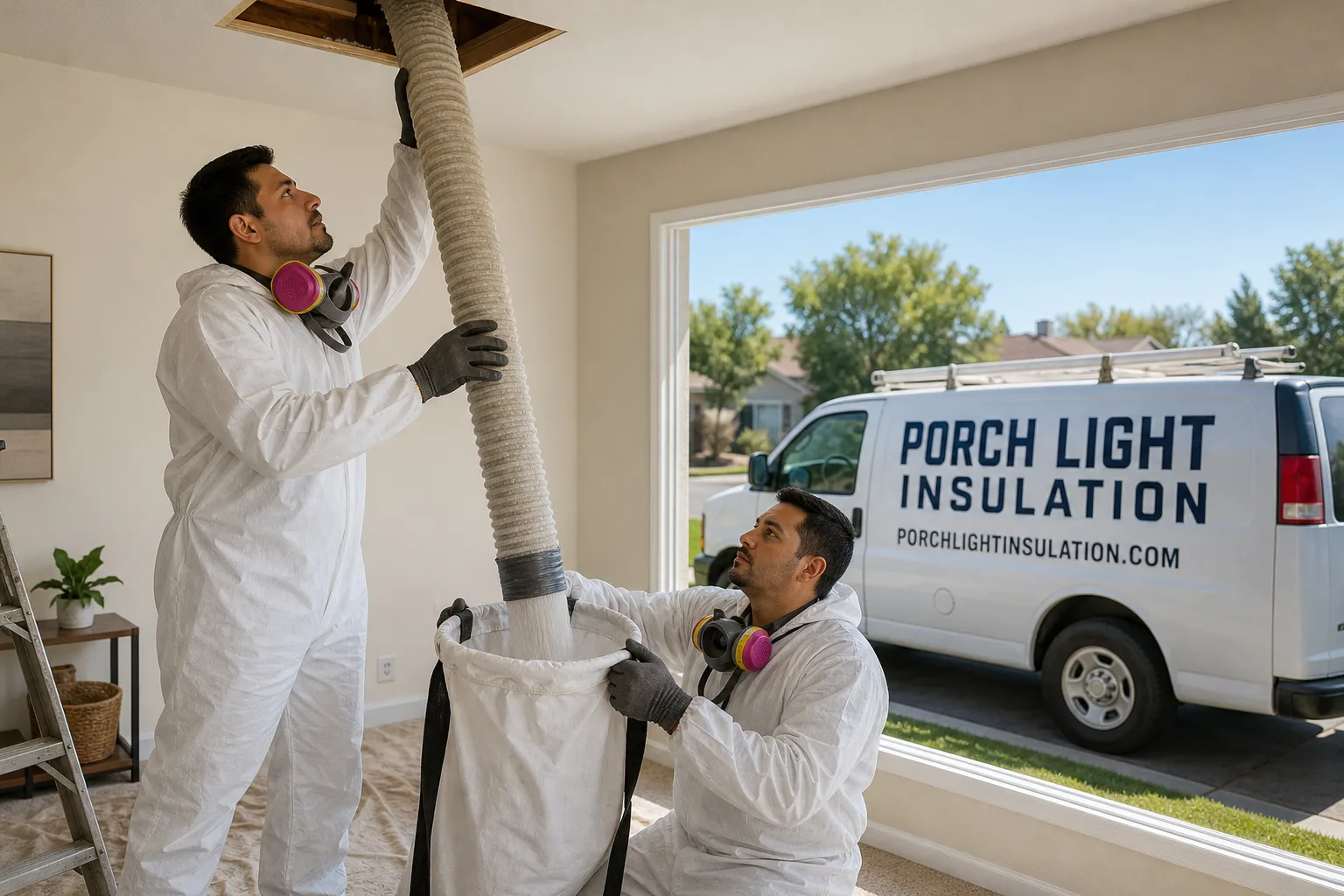
Attic Insulation Removal in Shadow Hills is frequently a wildlife-driven job, not a renovation afterthought. Rats and squirrels chew through fiberglass batts, tunnel through loose fill, and leave droppings throughout the attic. Once that happens, adding new insulation on top doesn’t fix anything. The contaminated material has to come out, the entry points have to be sealed, and only then can fresh insulation go in.
Removal and disposal for a typical 1,200 to 1,800 square-foot attic in Shadow Hills runs $1,500 to $3,200. If we’re also sealing rodent entry points, that’s usually another $400 to $900. The full removal-and-reinsulation package often lands between $3,500 and $7,000. Gil Tanner’s crew can usually complete removal in a single day, with re-insulation scheduled right behind it.
Rodent-Contaminated Batts in Older Horse Properties
Older Shadow Hills homes and outbuildings often have open soffit gaps and unsealed wall cavities. Rodents use them as highways. The insulation ends up compacted, soiled, and functionally dead. Removing it isn’t optional; it’s the first step in reclaiming the attic.
Sealing Before Re-Insulating
A removal job that skips sealing is a waste of money. Our crews block entry points with metal mesh and foam, secure vent openings with wildlife-rated screens, and only then install fresh material. That sequence is the difference between a five-year fix and a twenty-year fix.
Trusted Brands We Service in Shadow Hills
Porch Light Insulation is authorized to install products from eight leading manufacturers, and for Shadow Hills we lean on a few workhorses. GreenFiber cellulose goes into older ranch attics where loose-fill coverage and air-sealing matter most. Owens Corning fiberglass batts handle straightforward vented attics. Demilec closed-cell spray foam tackles cathedral ceilings and framing bays that need both R-value and air-seal in one pass. We keep core materials staged for rapid deployment to 91040, which means fewer scheduling delays when you’re ready. Eight manufacturers, one goal: the right fit for your specific situation.
Common Attic Insulation Problems We See in Shadow Hills Homes
- Rodent-tunneled and compacted batts. We see this constantly in Shadow Hills attics, especially on lots backing up to open canyon or brush. Rats nest in the insulation, compress it, and destroy the R-value. The fix is removal, sealing, and fresh material, not topping it off.
- Radiant heat frying mid-century attics. Ranch homes built in the 1950s and 60s rarely met modern energy code. Attic temperatures in July can hit 140 degrees in this canyon, which bakes insulation and spikes cooling bills. A radiant barrier or upgraded R-49 insulation makes a noticeable difference upstairs.
- Open wall cavities in barns and detached garages. Horse properties often have hay lofts, tack rooms, and garage attics with unsealed framing. Those spaces become wildlife entry corridors and insulation graveyards. Sealing them is part of any proper attic job here.
- Gaps where old construction meets new additions. Shadow Hills has plenty of homes expanded over decades, and the transition lines between old and new framing are rarely sealed well. We find thermal bridges at those seams on almost every custom addition we insulate.
Pricing for Attic Insulation in Shadow Hills, CA
Here’s what Shadow Hills homeowners can expect. A simple attic top-up with blown-in GreenFiber cellulose runs $900 to $2,000 for most single-story ranch homes. Full removal of old batt insulation and re-insulation to R-49 typically lands between $3,000 and $6,500. If you have a custom home with multiple outbuildings, a detached garage, or a horse barn with conditioned space, total scope can reach $9,000 to $14,000. Spray foam costs more per square foot but delivers air-sealing that fiberglass can’t match, especially on cathedral ceilings and unvented roof decks. Every quote is free, and you’ll get itemized pricing before you commit. Call (877) 521-4987 and we’ll set up a walkthrough.
We Also Serve Cities Near Shadow Hills
Porch Light Insulation runs crews throughout the northeast San Fernando Valley and the foothill communities. Beyond Shadow Hills, we regularly work in Sunland, Tujunga, La Crescenta-Montrose, and Burbank. If you’re in one of those areas and need a specialist, call the same number and ask for an attic assessment.
Serving Shadow Hills, CA — Our Local Coverage Area
We’re based in the Shadow Hills area and know this community well. Use the map below to see our service coverage — if you’re nearby, we can almost certainly help.
FAQs About Attic Insulation in Shadow Hills
Shadow Hills attics that have been tunneled by rats or squirrels require full removal of the contaminated insulation before anything else happens. Adding new material over soiled, compacted batts locks in odor, allergens, and fire risk. Our removal process includes sealing entry points so the problem doesn’t repeat. Call (877) 521-4987 for an inspection.
A 1950s ranch with standard vented attic framing does well with blown-in GreenFiber cellulose at R-49, often paired with a radiant barrier to fight the canyon’s afternoon sun. If the roof deck is unvented or there’s a cathedral ceiling over part of the home, Demilec closed-cell spray foam is the better call. We quote both and let the framing decide.
Yes. Mold removal is contained inside the attic space and doesn’t require demolition or structural changes. For detached barns and guest structures with attached attic areas, we isolate the workspace and use negative air to keep spores from spreading to adjacent stalls or storage. Most jobs are done without any disruption to the horse operation below.
We seal first, then insulate. That means blocking soffit gaps, chimney chases, and plumbing penetrations with metal mesh and expanding foam before any new insulation goes in. For homes backing up to open canyon, we also recommend checking vent screens and eaves as part of every insulation job. Sealing is standard on our Shadow Hills quotes. Call (877) 521-4987 to schedule a walkthrough and we’ll point out exactly where wildlife is getting in.
It is, because each structure has its own framing, venting, and wildlife access points. A main house, detached garage, horse barn, and guest unit each need their own removal scope and their own sealing plan. We treat every structure individually rather than applying one blanket approach across the property. For multi-structure lots, we quote the full picture so you can see where the money goes.
Written by Gil Tanner, Owner at Porch Light Insulation, serving Shadow Hills and the surrounding San Fernando Valley since 2009.