
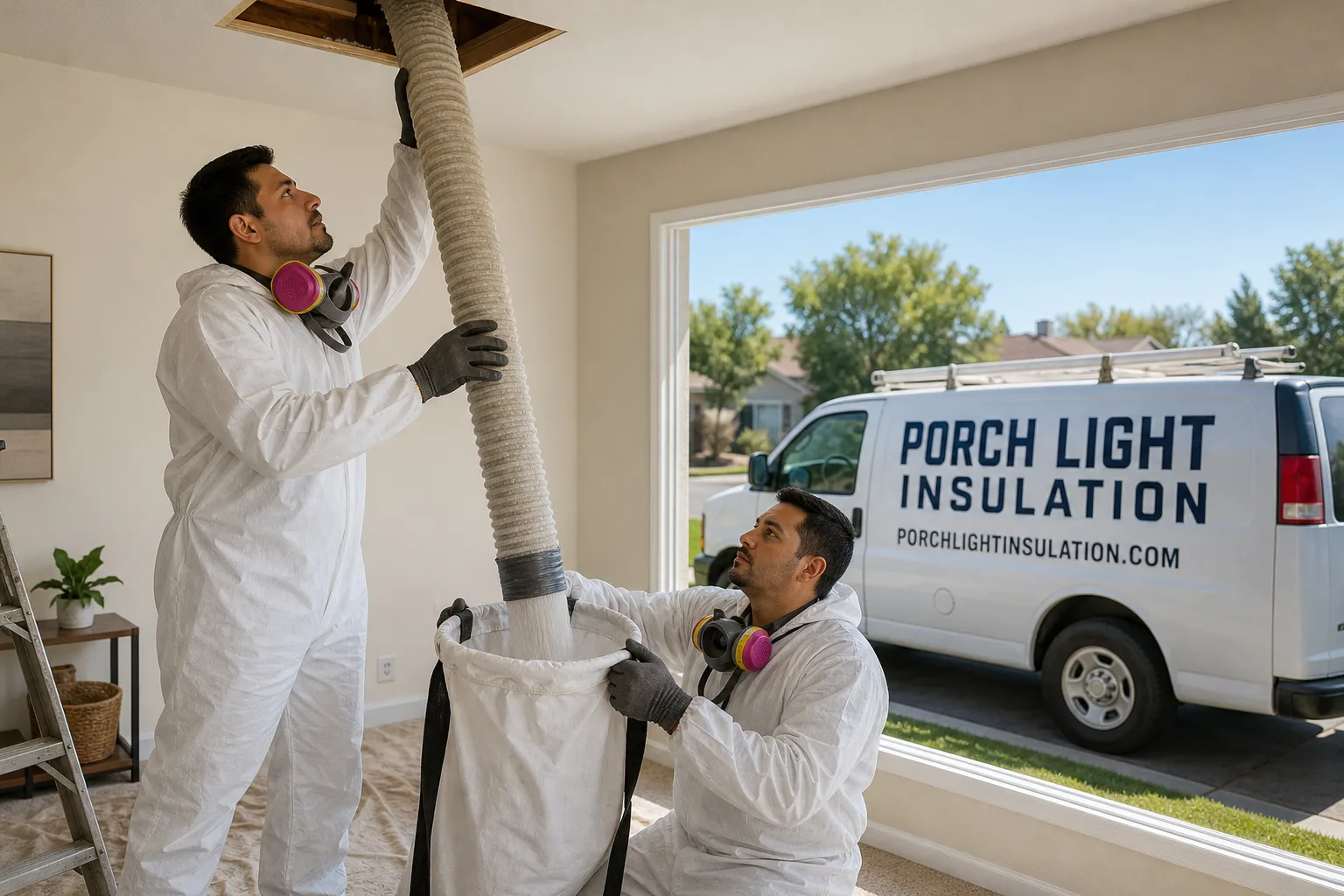
Fast, Reliable Attic Insulation Across Tujunga
Attic insulation in Tujunga is a different job than it is down in the flatlands. The summer sun beats on foothill roofs until attic cavities hit 140°F or more, and that heat doesn’t just sit up there – it pushes down into bedrooms, kitchens, and living rooms until your AC runs constantly and still can’t keep up. We’re Porch Light Insulation, and we’ve spent years working inside Tujunga attics, from the ranches off Foothill Boulevard to the cabins along the Angeles National Forest edge. Insulation is all we do, which means it’s all we’ve mastered. Call (877) 521-4987 for a free estimate, and we’ll tell you exactly what your attic needs and what it’ll cost.
Why Porch Light Insulation Is Tujunga’s Preferred Attic Insulation Company
The reason Tujunga homeowners call us first is simple: we only do insulation. Not roofing, not HVAC, not remodeling on the side. Every estimator who climbs into your attic and every installer who pulls the hose line knows insulation science down to the building-envelope level. Gil Tanner founded Porch Light with one goal – match the material to the home, not to whatever’s sitting in a warehouse. That’s why we carry products from eight manufacturers: Owens Corning, Johns Manville, Knauf, Rockwool, CertainTeed, Icynene, Demilec, and GreenFiber. If your Tujunga attic needs fire-resistant mineral wool near the ember-exposed vents, we spec Rockwool. If it needs air sealing plus R-value over an unpermitted addition, we might go with Demilec closed-cell foam. Eight manufacturers, one goal: the right fit for your specific situation.
Tujunga-specific experience matters more here than almost anywhere in Los Angeles. We’ve worked attics on the west side of town near the flood-control basin, up in the hills off Oro Vista Avenue, and in the mid-century pockets between 91042 and 91043. The housing stock isn’t uniform, and neither are the insulation failures. That local knowledge shapes every quote we write.
Insulation Contractors in Tujunga
Insulation contractors in Tujunga face a specific challenge: the majority of homes here were built between the 1940s and 1970s, and most have never had their attic insulation touched. Original fiberglass batts are thin, settled, or completely gone over additions that were never properly permitted. For a typical 1,200-square-foot Tujunga ranch, a full attic insulation top-up with air sealing runs $1,800 to $3,200 depending on depth and access. If you’ve got knob-and-tube wiring that needs to be addressed first, plan for additional electrical work before insulation goes in.
Blown-In Attic Insulation in Tujunga
For older foothill homes with irregular joist spacing, low-slope roofs, or additions with disconnected cavities, blown-in insulation is usually the right call. We run Owens Corning and GreenFiber loose-fill because it conforms to odd framing and fills gaps that batts can’t reach. A typical blown-in upgrade to R-49 in Tujunga runs $1,500 to $2,800.
Attic Insulation Top-Up
If your existing insulation isn’t damaged but is just too thin, a top-up is the most cost-effective move. We add fresh material over what’s already there after checking for moisture and air leaks. Top-ups in Tujunga attics generally run $900 to $1,700 for a standard ranch footprint.
Attic Ventilation in Tujunga
Attic ventilation in Tujunga isn’t optional – it’s a fire-safety and moisture-control issue. Santa Ana winds push ember-laden air toward foothill homes, and if your gable vents, soffit vents, and baffles aren’t doing their job, that air finds its way into the attic cavity. Older Tujunga cabins often have gable vents without screens or baffles, and unsealed recessed light housings create direct pathways from the living space into the attic. We routinely see attics where heat buildup is causing the insulation to underperform simply because air can’t move. Ventilation correction and baffle installation before adding insulation typically costs $400 to $900 on a standard Tujunga home.
Attic Baffles and Ventilation Prep
Before any blown-in insulation goes down, we make sure the attic can breathe. That means installing baffles at every rafter bay, clearing blocked soffit vents, and sealing around light housings. On ember-exposed properties along the forest edge, we also recommend ember-resistant vent screens – a detail flatland jobs never touch.
Insulation Replacement After Ventilation Repairs
If your old insulation has been sitting under a leaking or under-ventilated roof for decades, it’s often degraded to the point where top-up won’t help. We remove matted, mouse-damaged, or moisture-compromised material and start fresh. Full replacement with disposal in a Tujunga attic typically lands between $2,200 and $4,000.
Trusted Brands We Service in Tujunga
We stock and install products from Owens Corning, Johns Manville, Knauf, Rockwool, CertainTeed, Icynene, Demilec, and GreenFiber. For Tujunga’s foothill homes, we lean on Owens Corning blown-in fiberglass for most standard attics, GreenFiber for dense-pack applications in irregular cavities, and Demilec closed-cell spray foam where air sealing is the priority. Because we keep material stocked and have crews routed through the Sunland-Tujunga corridor weekly, turnaround for Tujunga jobs is typically fast – often within a week of your estimate.
Common Attic Insulation Problems We See in Tujunga Homes
- Unpermitted additions with no insulation at all. The main house might be insulated, but the rear addition added in the 1970s or ’80s often has bare drywall backs and nothing between the ceiling and the roof. That room bakes in summer and freezes in winter. We insulate those additions as separate zones with dedicated access and proper baffling.
- Thin, settled 1950s batts in ranch-style homes. Mid-century Tujunga ranches off the 210 corridor typically have R-11 or less in the attic – far below the R-49 recommended for this climate. Settled fiberglass loses loft, and once it’s matted down, its R-value drops hard.
- Knob-and-tube wiring buried under old insulation. Homes built in the 1940s and early ’50s often still have active knob-and-tube runs. Adding insulation on top of those conductors can trap heat and create a fire hazard. We always inspect first and flag any wiring that needs attention before we install.
- Ember intrusion through aging vents during Santa Ana events. Gable vents without proper screening let wind-driven embers into the attic cavity. Combined with dry, settled insulation from the Bush era, that’s a real ignition risk on properties near the Angeles National Forest boundary.
Pricing for Attic Insulation in Tujunga, CA
A typical blown-in attic insulation job in Tujunga runs $1,800 to $3,200 for a 1,100 to 1,500-square-foot ranch home. Attic batt insulation for new construction or a full tear-out typically lands between $1,400 and $2,600. Top-ups are the most affordable path at $900 to $1,700, while full replacement with disposal runs $2,200 to $4,000. Spray foam jobs – whether open-cell for air sealing or closed-cell for vapor control – start around $3,500 and go up based on roofline complexity and square footage. What moves the number: access difficulty, whether knob-and-tube wiring needs addressing, how much old material must come out, and the R-value you’re targeting. Call (877) 521-4987 for a free, itemized estimate – no guesswork, just numbers.
We Also Serve Cities Near Tujunga
Our crews work throughout the Tujunga foothills and the surrounding communities. If you’re in Sunland, La Crescenta-Montrose, Shadow Hills, or Burbank, you’re in our regular service area. Many of our Attic Insulation in Tujunga customers ask us to handle parent’s homes or rental properties in those neighboring towns, and we’re glad to.
Serving Tujunga, CA — Our Local Coverage Area
We’re based in the Tujunga area and know this community well. Use the map below to see our service coverage — if you’re nearby, we can almost certainly help.
FAQs About Attic Insulation in Tujunga
Yes. Unpermitted additions are extremely common in Tujunga, and we insulate them every week. The key is treating that space as a separate zone – physically disconnected from the main attic – so it gets its own inspection, its own baffles, and often its own insulation depth. We don’t require permits to add insulation to an existing structure, and we’ve insulated dozens of Tujunga additions that other contractors wouldn’t touch. Call (877) 521-4987 and tell us about your addition – we’ll walk you through exactly what’s involved.
Wildfire season changes the conversation from “what’s cheapest” to “what’s safest.” Homes along the Angeles National Forest edge – especially those in ember-exposed zones – benefit from mineral wool like Rockwool, which is non-combustible and doesn’t lose R-value under flame exposure. We also recommend ember-resistant vent screens and air sealing around any attic penetration so Santa Ana winds can’t push sparks into the cavity. Your insulation choice should account for the fire load on Tujunga’s dry, drought-hardened foothills. We match the material to your specific exposure, not to our inventory.
R-49 is our standard recommendation for Tujunga attics, which is about 16 inches of blown-in fiberglass or the equivalent in mineral wool. That depth handles the 140°F summer attic temperatures without letting heat transfer into the living space, and it also holds warmth on those 40°F winter nights you get at elevation. Homes with spray foam can often hit effective performance at lower depth because the air sealing changes how the whole assembly performs – but for a standard blown-in job, R-49 is the number we quote. Get an exact recommendation by calling (877) 521-4987.
Yes, but it requires a deliberate sequence. Adding insulation on top of active knob-and-tube runs traps heat and can create a fire hazard, so we always flag any visible knob-and-tube during our inspection. If the wiring is in good shape and properly routed, we can sometimes work around it by putting shielding in place and keeping insulation clear of the conductors. If it’s deteriorated – common in Tujunga cabins that have been cooking under a hot roof for 70 years – we’ll recommend you have an electrician address it first. We don’t bury live wiring, and we won’t pretend it’s fine to save a few dollars.
The biggest mistake is treating the whole attic as one uniform space when it’s actually two or three disconnected cavities. Tujunga’s mid-century homes are full of unpermitted additions, dormer conversions, and enclosed porches – all with framing that doesn’t connect to the main attic. You blow insulation into the primary cavity and those other spaces stay at exterior temperature. That’s how you get a back bedroom hitting 95°F in August while the rest of the house is comfortable. We recently worked a 1958 ranch off Marengo Drive in Tujunga where the homeowner’s unpermitted rear addition had no attic insulation at all – just bare drywall backs and open framing. Our crew air-sealed the top plates and canned lights, then installed R-49 of Owens Corning blown-in fiberglass across the main attic and a separate R-38 blanket over the addition, and the back bedroom finally stopped hitting 95°F on August afternoons. The fix isn’t more insulation overall – it’s insulation in the right places.
If your Tujunga attic is under-insulated, over-heated, or has spaces that never got the attention they needed, call Porch Light Insulation at (877) 521-4987. We’ll inspect the whole system – attic, additions, ventilation, and existing material – and give you a straight answer on what will fix it and what it’ll cost. Free estimates, no pressure, just insulation done right. From blown-in attics to closed-cell spray foam, we compare options so you don’t have to guess.
Written by Gil Tanner, Owner at Porch Light Insulation, serving Tujunga and the surrounding foothill communities.