
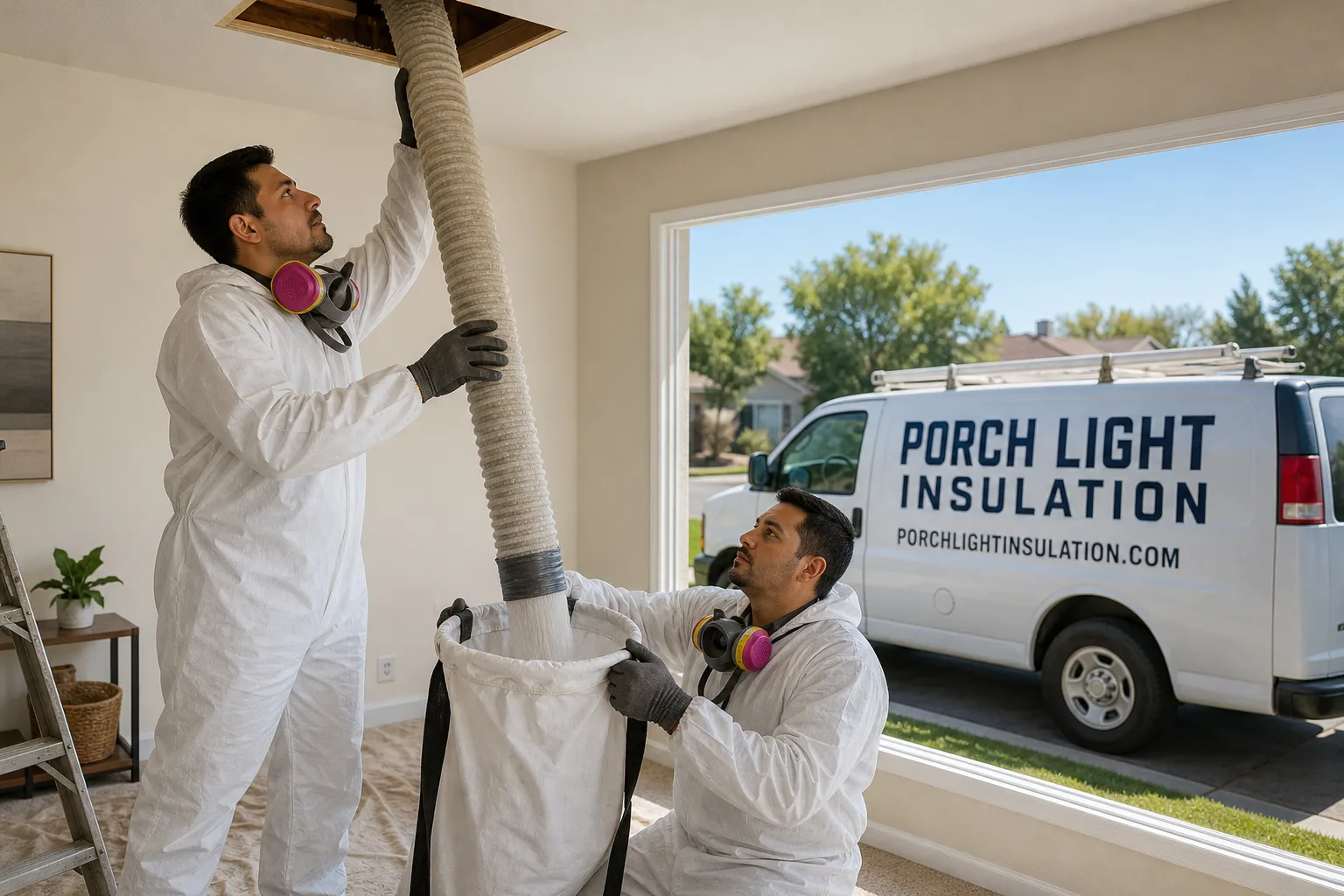
Fast, Reliable Spray Foam Insulation Across Koreatown
Spray foam insulation in Koreatown usually runs $2.50 to $6.80 per square foot for open-cell, and $3.90 to $8.90 per square foot for closed-cell, depending on cavity depth and whether the job is tied to a seismic retrofit or fire-rated assembly. Our crew reaches most of 90005 within 30 to 45 minutes from Universal City, so same-week starts are common even when the project involves HOA sign-off or a structural engineer’s inspection. Gil Tanner founded Porch Light Insulation specifically to keep crews focused on one trade, because spray foam in Koreatown’s dense apartment stock rarely behaves like a simple attic job in the suburbs.
If you’re dealing with a retrofit that just punched holes in your roof deck, or you’ve got unit-to-unit noise bleeding through a shared wall, call (877) 521-4987 for a straight answer and a free estimate. We’ll tell you what open-cell and closed-cell actually do in a Koreatown building, not just what the brochure says.
Why Porch Light Insulation Is Koreatown’s Preferred Spray Foam Insulation Company
Koreatown gives insulation contractors a specific kind of test. Buildings along Wilshire Boulevard, Olympic Boulevard, and Vermont Avenue aren’t single-family ranchers with a clean attic hatch. They’re 1970s mixed-use blocks, 1990s condo conversions, and the occasional 1920s Spanish Colonial bungalow with decades of unpermitted re-roofing layered on top. Our estimators are trained for that reality. When we walk into a 90005 building, we’re looking for fire separation between units, existing vermiculite that needs testing, and retrofit sequencing, because those factors determine whether spray foam is even the right material for the cavity.
Insulation is all we do, which means it’s all we’ve mastered. We don’t show up with a roofer’s referral or a general contractor’s side crew. Every Porch Light installer works with spray foam, blown-in, and batt insulation every week, and we carry an eight-manufacturer bench so the right product gets selected for the specific wall or roof assembly in front of us. We match the material to your home, not to our inventory.
Open Cell Spray Foam in Koreatown
Open Cell Spray Foam is the most common air-sealing material we install in Koreatown attic and roof-deck cavities, especially after a seismic retrofit exposes the underside of the roof sheathing. It’s a lower-density foam that expands into cavities and seals penetrations, plumbing stacks, and roof-to-wall junctions far better than fiberglass batts. In 90005, the highest-value application is usually air-sealing a roof deck that was just opened for structural work, because that’s the moment when all the bypass gaps become visible and accessible.
Koreatown homeowners choose open-cell when the goal is air sealing and noise reduction inside the building rather than maximum R-value per inch. It costs between $2.50 and $6.80 per square foot of applied area, and most of the jobs we quote in 90005 land in the $3,200 to $7,500 range for a typical attic or shared-wall retrofit. It’s not a vapor barrier, and it doesn’t belong in a below-grade or flood-prone cavity, but for Southern California’s dry climate that’s rarely the limiting factor.
When Open Cell Makes Sense
Open-cell foam is the right call when you need to seal irregular cavities, block unit-to-unit sound transfer through shared walls, or air-seal a roof deck without adding the condensation risk that closed-cell sometimes introduces in older Koreatown assemblies. We also recommend it for rim joists and band joists in wood-frame 1960s and 70s apartment buildings, where heat gain through the floor line is a bigger comfort problem than heating loss.
Typical Open Cell Installations
Most of our Koreatown open-cell work happens in attics, roof decks exposed by retrofits, and interior shared-wall cavities that have been opened for plumbing or electrical work. The foam goes on as a liquid, expands within seconds, and cures to a soft, spongy texture that deadens sound and eliminates air movement. Clients along 6th Street and near the Wilshire Center have also used open-cell to quiet HVAC chases that run through multiple units.
Spray Foam Insulation Contractors in Koreatown
Spray Foam Insulation Contractors in Koreatown are not interchangeable. The building stock here demands someone who reads a crawlspace in a 1927 bungalow differently than a 1979 fourplex roof deck. Porch Light runs insulation-specific crews, not general tradespeople picking up a foam gun as a side gig. Gil Tanner built the company so every estimator can speak to fire-blocking requirements, California Title 24 energy code, and the realities of HOA coordination in 90005.
The job involves more than shooting foam into a cavity. On a typical Koreatown project, we inspect for degraded cellulose or vermiculite before any foam goes in, confirm fire-rated assembly details on shared walls, and sequence the insulation work with the structural retrofitter so neither crew gets in the other’s way. For spray foam only, a Koreatown homeowner should expect to pay according to the square footage and cavity depth we quote, with open-cell running $2.50 to $6.80 per square foot and closed-cell $3.90 to $8.90.
Project Walkthrough
We start with a free site visit, phone consultation, and written quote that breaks out material options side by side rather than steering you toward whichever product has the best margin. You’ll see open-cell and closed-cell figures on the same sheet, along with notes on any fire-blocking or asbestos testing that the building will require before foam can be applied. From blown-in attics to closed-cell spray foam, we compare options so you don’t have to guess.
Timeline and Coordination
Koreatown projects typically take one to three days for the foam application itself, with additional time for inspection sign-offs when a structural engineer or HOA is involved. We’ve worked on 90005 buildings where the drywall couldn’t go back up until the engineer signed off on our fire-blocking, so we sequence our work around those inspections rather than treating them as an afterthought.
Trusted Brands We Service in Koreatown
Porch Light Insulation installs products from eight leading manufacturers including Owens Corning, Johns Manville, Knauf, Rockwool, CertainTeed, Icynene, Demilec, and GreenFiber. For Koreatown spray foam work, we most often reach for Icynene and Demilec open-cell foams because of their expansion properties and low-VOC curing profile, while closed-cell options from Johns Manville cover the higher-R-value and fire-blocking demands of shared-wall assemblies. Eight manufacturers, one goal: the right fit for your specific situation. We keep our Koreatown quotes manufacturer-agnostic so the material recommendations come from the building’s needs, not from a vendor relationship.
Common Spray Foam Insulation Problems We See in Koreatown Homes
- Foam applied over untested vermiculite or degraded cellulose. In the 1920s bungalows around Normandie and Harvard Heights, old attics often hold vermiculite that must be tested for asbestos before any spray foam goes in. Skipping this step can seal a hazardous material into the roof cavity and create a costly abatement problem later.
- Open-cell foam in exterior wall cavities without addressing radiant heat gain. Koreatown’s warm summers mean the sun beating on stucco and wood siding drives way more cooling load than winter heating loss. If the wall cavity gets open-cell without an exterior radiant strategy, summer cooling bills stay high.
- Missing fire-rated assembly details in shared walls. We regularly see foam installed in the party wall between two apartments without the intumescent coating or mineral wool fire-blocking that the building code requires. That puts the whole building’s occupancy approval at risk.
- Air sealing gaps left after seismic retrofit penetrations. The retrofit opened the wall, but the insulation contractor never came back to seal around the new shear wall anchors, hold-downs, or roof-to-wall junctions. Air leaks and noise transfer return within a season.
Pricing for Spray Foam Insulation in Koreatown, CA
Open-cell spray foam in Koreatown typically runs $2.50 to $6.80 per square foot, while closed-cell lands between $3.90 and $8.90 per square foot. A typical shared-wall fire-blocking detail in a 90005 condo might run $1,900 to $3,600, and a full attic air-seal after a roof-deck retrofit usually falls between $3,800 and $8,200. The biggest cost drivers are cavity depth, access awkwardness in old mid-rise buildings, and whether asbestos testing or engineer inspections are required. Don’t try to compare these numbers to a new-construction tract home in the Inland Empire; Koreatown’s retrofit coordination, HOA paperwork, and fire-rated detailing add real labor hours. Call (877) 521-4987 for a free, written estimate that breaks everything down line by line.
We Also Serve Cities Near Koreatown
Our crews work throughout the neighborhoods surrounding Koreatown, including Los Angeles, Echo Park, Silver Lake, and Hollywood. If you’re in a nearby 90005-adjacent zip and need a Spray Foam Insulation specialist who already knows the building patterns and retrofit timelines of the neighborhood, we can usually schedule within the week.
Serving Koreatown, CA — Our Local Coverage Area
We’re based in the Koreatown area and know this community well. Use the map below to see our service coverage — if you’re nearby, we can almost certainly help.
FAQs About Spray Foam Insulation in Koreatown
Yes, and in most 1970s-2000s mid-rise buildings along the Wilshire corridor it’s actually the best time to do it, because the roof deck and exterior walls are already opened for the structural work. Spray foam can be applied to the newly exposed cavities before the drywall goes back up, sealing the penetrations the retrofit just created and restoring fire-blocking in shared walls. Coordinate with your structural engineer first; Porch Light regularly sequences our foam work around retrofit inspections in 90005. Call (877) 521-4987 and we’ll help you time it right.
Yes, in any bungalow attic from the 1920s you should test for asbestos in the existing vermiculite, cellulose, or pipe insulation before any spray foam goes on top. Koreatown has hundreds of original Spanish Colonial and Craftsman-era homes around Normandie and Western that were re-roofed without permits, and vermiculite is surprisingly common. Porch Light won’t spray over suspect material; we’ll refer the testing and, if needed, abatement before we ever open the foam gun.
Yes, open-cell spray foam does a strong job reducing unit-to-unit noise transfer through shared walls, especially in 1960s and 70s wood-frame buildings that have no acoustical separation. But the foam has to be installed as part of a fire-rated assembly, with the proper intumescent coating or mineral wool detailing to satisfy the building code. We do that regularly in 90005 condo buildings. Call (877) 521-4987 for an evaluation of your specific shared-wall condition.
Yes, because Koreatown’s hot, dry summers mean most buildings lose more money to radiant heat gain through walls and roof decks than to heating loss in winter. An air-sealed open-cell roof deck or properly detailed exterior wall cavity can cut summer cooling load noticeably, especially during Santa Ana conditions. But the material choice matters: open-cell in an exterior wall won’t address radiant heat by itself, so our quotes pair the right foam with the right cavity design.
We’re authorized to install spray foam from Icynene, Demilec, and Johns Manville, among the eight manufacturers in our bench, and we choose based on the specific assembly rather than a house brand. For Koreatown building retrofits we usually specify Icynene or Demilec open-cell for air sealing and noise, and shift to closed-cell for fire-blocking and high R-value demands. Call (877) 521-4987 and we’ll walk you through which product makes sense for your walls, not our inventory.
Written by Gil Tanner, Owner at Porch Light Insulation, serving Koreatown and greater Los Angeles since day one.