
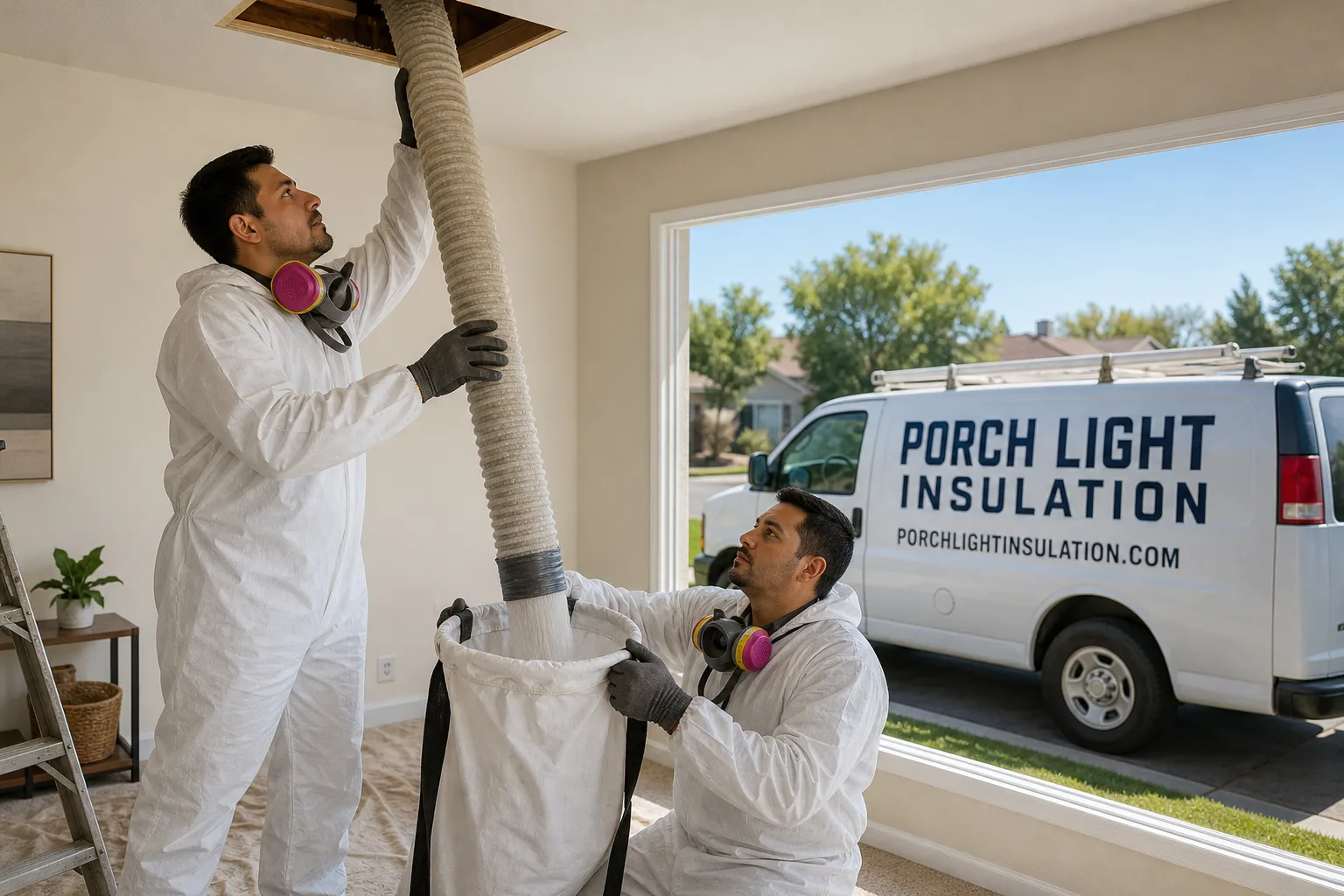
Fast, Reliable Spray Foam Insulation Across Topanga
Most Topanga homes were never built for standard insulation. The canyon’s hand-framed cabins, redwood post-and-beam houses, and owner-built additions from the 1920s through the 1970s have wall cavities that don’t match any manufacturer’s batt chart. That’s exactly why spray foam is often the only material that fits here. Our crews work Topanga Canyon Blvd, Old Topanga Canyon Road, and the hillside streets off Saddle Peak and Fernwood Pacific every week. We know these houses. Call (877) 521-4987 for a free estimate, and we’ll tell you honestly whether open cell or closed cell belongs in your specific assembly.
Why Porch Light Insulation Is Topanga’s Preferred Spray Foam Insulation Company
Insulation is all we do. Gil Tanner built Porch Light as a single-trade shop, so the estimator who shows up at your Topanga door only thinks about insulation. Not roofing, not HVAC, not the next remodel job. That matters in a canyon where every house is different and no two wall cavities match. We’re authorized to install products from eight manufacturers, including Icynene and Demilec for spray foam, which means we pick the foam that suits a hand-framed canyon wall or an open-rafter ceiling rather than pushing whatever’s on the truck. When a Topanga homeowner calls about a baked attic or a drafty rim joist, we get there fast and we diagnose the assembly before we quote it.
Topanga homeowners consistently tell us the same thing: other contractors looked at their house, said “non-standard,” and left. Our crew works non-standard every day.
Open Cell Spray Foam in Topanga
Open cell spray foam in Topanga typically costs $1.10 to $2.00 per board foot installed, depending on depth and surface prep. In a canyon where many homes sit on steep slopes and most wall cavities were framed by hand, open cell is often the first material we reach for. It expands to fill irregular bays, locks against mixed-dimension studs, and creates an air barrier that standard batts simply cannot achieve. It also stays vapor-permeable, which matters when you’re dealing with redwood and post-and-beam assemblies that were never designed for trapped moisture.
Sealing Hand-Framed Canyon Walls
Because most Topanga canyon cabins were owner-built without permits, spray foam here is often the only way to seal a non-standard wall cavity. There is no uniform stud bay or sheathing plane to fall back on, so every assembly has to be foamed to the framing as it actually exists. Open cell conforms to that reality and gives a continuous air barrier without the rigid assumptions of batt or board stock.
Open Cell on Interior Partition Walls
In Topanga homes, interior walls often share the same irregular framing as exterior ones, and heat passes through them the same way. Open cell works well here because it damps noise between rooms, which matters when you live in a canyon with echoing road noise off Topanga Canyon Blvd and limited wall mass.
Spray Foam Insulation Contractors in Topanga
Hiring spray foam insulation contractors in Topanga means finding someone who actually understands canyon framing. A typical full-attic spray foam job in Topanga runs $3,800 to $8,500 depending on square footage and whether the roof deck is open-rafter or conventionally sheathed. Rim joist work runs $1,400 to $2,800. Garage ceiling jobs run $950 to $2,200. Every one of those starts with a real inspection of the framing you have, not the framing a product brochure assumes you have. Our Spray Foam Insulation team is trained across both open-cell and closed-cell lines, so the recommendation matches the surface.
Rim Joist and Garage Ceiling Work
Hillside homes off Topanga Canyon Blvd often have vented crawlspaces where the rim joist is wide open to wind and rodents. Foaming those bays closes the air path and keeps ember entry points sealed at the plate. Garage ceilings are a common source of heat bleed into living space, especially in cabins where the garage was added as an afterthought and never insulated.
Roof Deck Selection Per Slope
Hot, dry inland-canyon summers mean Topanga attics bake past 140 degrees, while cool coastal-influenced nights swing temperatures the other direction. Closed cell on the roof deck handles radiant heat better and adds structural racking strength, which matters on steep, fire-prone slopes where wind loading is real. Open cell stays on interior surfaces where vapor movement matters more than R-value per inch.
Trusted Brands We Service in Topanga
We stock and install Icynene and Demilec spray foam lines, and we keep both available for Topanga jobs so the material decision is driven by your assembly, not our inventory. Both manufacturers make open-cell and closed-cell products, and we’re factory-authorized for each. For Topanga homeowners who want fiberglass or mineral wool options as a comparison point, we also carry Owens Corning and Rockwool. Eight manufacturers, one goal: the right fit for your specific situation.
Common Spray Foam Insulation Problems We See in Topanga Homes
- Sprayed foam over unsealed, hand-framed canyon walls traps moisture against redwood and post-and-beam members that were never built with a cavity standard. If the sheathing has gaps or the framing is mixed-dimension, moisture can condense behind closed cell before the foam ever cures properly. We check the assembly first, not the square footage.
- Open-rafter ceilings and vented crawlspaces in hillside homes let rodents chew through foam and insulation during fire-season evacuations. When houses sit empty for days or weeks during Santa Ana events, rats and mice move in through the same vents that are supposed to keep the space dry. We see chewed, compressed, or completely missing insulation after nearly every evacuation return.
- Attics that bake in inland-canyon summer heat and swing cold at night stress foam adhesion on irregular, unpermitted sheathing that was never prepared for it. Dust, old tar paper fragments, and wood that’s been through forty Topanga summers all reduce the surface bond. We prep for this specifically.
- Wind-driven ember paths at the top plate and rim joist that standard insulation never touches. In Topanga, wildfire hardening is not a sidebar conversation. Foam sealing at the plate closes the same gaps embers find, and closed cell adds a burn-resistant layer at the rim where wind pushes fire.
Pricing for Spray Foam Insulation in Topanga, CA
Spray foam pricing in Topanga runs higher than the LA basin average because most jobs involve non-standard framing, steep access, and prep work on irregular sheathing. Open cell runs $1.10 to $2.00 per board foot installed. Closed cell runs $2.10 to $3.40 per board foot. A rim joist job runs $1,400 to $2,800. A typical hillside attic runs $3,800 to $8,500. The biggest cost drivers are surface prep on old unpermitted framing, access on steep lots, and the choice between open and closed cell per assembly. We quote free, and we itemize every surface so you see exactly what you’re paying for. Call (877) 521-4987 to schedule a walkthrough.
We Also Serve Cities Near Topanga
Our crews work throughout the Santa Monica Mountains and the surrounding basin. If you’re in Topanga and need service, we’re already nearby. We also handle spray foam jobs in Encino, Santa Monica, Northridge, and Sherman Oaks, many of which share Topanga’s mix of older canyon framing and newer hillside construction.
Serving Topanga, CA — Our Local Coverage Area
We’re based in the Topanga area and know this community well. Use the map below to see our service coverage — if you’re nearby, we can almost certainly help.
FAQs About Spray Foam Insulation in Topanga
Yes, that’s the primary reason we recommend open cell foam in Topanga’s owner-built cabins. Spray foam expands to fill whatever cavity actually exists, locking against mixed-dimension studs and creating a continuous air barrier where no standard batt would ever fit. On a redwood post-and-beam cabin off Topanga Canyon Blvd, our crew opened a wall and found mixed-dimension lumber, no continuous sheathing, and old batt compressed flat and rodent-chewed at the base plate. We foamed the irregular bays with open cell to close the ember path at the plate, then confirmed the vented crawlspace below stayed open to airflow. The homeowner finally had a continuous air barrier where no standard batt would ever have fit. Call (877) 521-4987 if you think your walls might be the same story.
Yes, closed cell foam at the rim joist, top plate, and roof deck helps close the same gaps wind-driven embers exploit. Topanga sits in one of the highest fire-severity zones in Los Angeles County, and the Santa Ana wind season brings extreme fire weather every fall. Sealing those irregular gaps with foam removes ember entry points that loose-fill or batt insulation leaves open. It’s not a standalone fireproofing solution, but it’s a meaningful part of hardening a hand-framed canyon home. Call (877) 521-4987 for an assessment of your specific assembly.
It depends on whether you use open cell or closed cell, and which direction your roof deck faces. In Topanga’s inland-canyon summer heat, attics bake and then swing cold at night, which stresses foam adhesion on old sheathing. Open cell stays vapor-permeable so moisture doesn’t get trapped against redwood or post-and-beam members. Closed cell works better for radiant heat rejection on south-facing decks. We evaluate the specific roof assembly and select per surface rather than per house. Call (877) 521-4987 and we’ll walk your roof with you.
Rodent intrusion is one of the most common issues we see in Topanga’s hillside homes. During fire-season evacuations, rats and mice move in through open vents and chew through foam and insulation at the base plate and rim joist. We routinely find chewed, compressed, or missing insulation after homeowners return. The fix is sealing the rim joist and plate with closed cell foam and screening the vents properly, so the crawlspace stays ventilated but the rodents stay out. Call (877) 521-4987 for an inspection.
We select per surface, not per house. Open cell goes on interior walls and irregular framing where vapor movement matters and where the foam needs to conform to non-standard cavities. Closed cell goes on roof decks, rim joists, and uphill-facing walls where radiant heat, wind loading, and ember resistance are the priority. Closed cell also adds structural racking strength, which matters on steep, fire-prone slopes. The decision comes from the actual assembly in front of us, and we explain the reasoning on the quote so you’re not left guessing. Call (877) 521-4987 for a free walkthrough and a per-surface breakdown.
Written by Gil Tanner, Owner at Porch Light Insulation, serving Topanga and the surrounding canyons since 2015.
Ready to get your Topanga home sealed correctly? Call (877) 521-4987 today for a free estimate. We’ll assess your specific framing, your specific heat profile, and your specific fire-hardening needs, then give you an honest per-surface quote with no guesswork.