
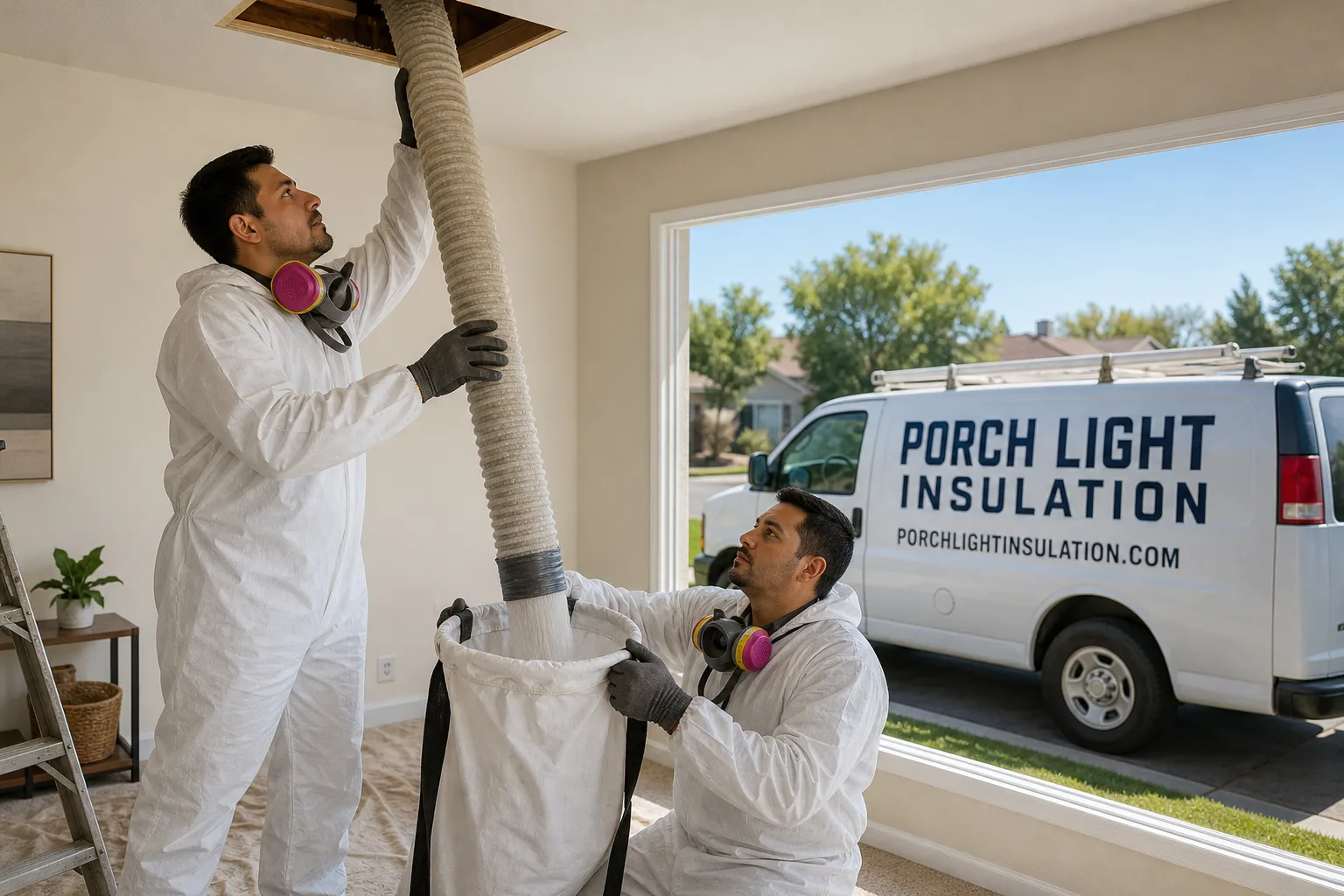
Fast, Reliable Attic Insulation Across Hacienda Heights
Most homes in Hacienda Heights were built between the 1950s and 1980s with R-7 to R-11 attic batts, and those batts are now 40 to 70 years old. In the San Gabriel Valley heat, attics regularly push past 140°F, which means thin, compressed insulation has been quietly costing you money every summer since the day it was installed. That’s the problem we solve daily. Porch Light Insulation serves all of 91745 and surrounding areas, and our crews know the difference between a flat tract ranch off Hacienda Boulevard and a sloped-ceiling hillside custom home off Turnbull Canyon. Both need attic insulation, but rarely the same approach. Call (877) 521-4987 to schedule a free estimate. We’ll look at your ceilings, your attic access, and your energy bills before recommending anything.
Why Porch Light Insulation Is Hacienda Heights’s Preferred Attic Insulation Company
Insulation is all we do. Our estimators don’t split attention between roofing and HVAC side work, and our installers aren’t general handymen picking up an insulation job between remodels. Every technician on a Hacienda Heights job is trained specifically in blown-in attic insulation, batt installation, spray foam, and dense-pack methods. That matters when a hillside home has no usable attic and the solution requires packing wall cavities rather than blowing a standard attic floor.
We carry products from eight manufacturers: Owens Corning, Johns Manville, Knauf, Rockwool, CertainTeed, Icynene, Demilec, and GreenFiber. That’s not a brag; it’s a procurement decision. Most insulation contractors carry one or two brands and steer every job toward whatever’s on the truck. We match the material to your home, not to our inventory. A 1960s slab-on-grade ranch in the flatlands doesn’t need the same product as a 1980s hillside cantilevered home backing the Puente Hills.
Gil Tanner founded Porch Light on the idea that homeowners deserve an insulation specialist who can compare methods on the same quote. From blown-in attics to closed-cell spray foam, we’ll show you the trade-offs in R-value, cost, and fire-resistance without nudging you toward the highest-margin product.
Attic Ventilation in Hacienda Heights
Attic ventilation in Hacienda Heights is not optional. An inland foothill attic that hits 140°F in August without proper airflow will cook your insulation, warp your roof deck, and push your air conditioner past its design duty cycle. In 91745, the most common ventilation problems we find are original soffit vents painted over by decades of exterior repaints, ridge vents that were never cut into homes that got new composition shingles, and powered attic fans that died years ago.
What a Ventilation Correction Involves
We inspect intake and exhaust balance, clear blocked soffits, install baffles where batts have been shoved against roof sheathing, and add ridge or box vents where heat has no escape path. A typical ventilation correction in Hacienda Heights runs $350 to $900 depending on roof geometry and how much existing ventilation is recoverable.
Hillside and Wildland-Edge Venting
Homes backing the Puente Hills get an extra step. Ember intrusion through unvented or underscreened roof vents is a real ignition pathway during Santa Ana wind events, so on those properties we detail vent screens and closures to fire-mitigation standards before we call the job done. This is the kind of detail flat-city insulation contractors don’t think about because they don’t have to.
Radiant Barrier in Hacienda Heights
Radiant barrier in Hacienda Heights is one of the highest-return upgrades you can make on a hillside home with a hot attic. A radiant barrier stapled to the underside of roof rafters reflects radiant heat before it can re-radiate onto your insulation and ceiling drywall. In an attic that regularly exceeds 140°F, that’s the difference between a second-floor hallway that feels like a sauna and one that holds at 80.
How We Install Radiant Barrier Locally
On a standard truss roof we staple the barrier to the rafter undersides, leaving a 1-inch air gap for reflectance. On sloped-ceiling hillside homes with minimal attic cavity, we integrate the barrier under the roof deck before closing the cavity or pair it with dense-pack wall work. Radiant barrier installation in Hacienda Heights typically runs $0.90 to $1.80 per square foot, depending on roof pitch, access, and whether you’re adding it alongside new insulation or retrofitting an existing attic.
Pairing Radiant Barrier With Insulation
A radiant barrier is not insulation. It reflects heat but doesn’t slow conductive transfer, so it works best when you layer it over a proper R-38 to R-49 attic insulation job. We’ll show you the numbers on your quote so you can see exactly what each layer contributes.
Trusted Brands We Service in Hacienda Heights
We’re authorized to install Owens Corning, Johns Manville, Knauf, Rockwool, CertainTeed, Icynene, Demilec, and GreenFiber. That breadth means a 1960s Hacienda Heights ranch with exposed rafters gets a different product than a new remodel behind Hacienda Boulevard with vaulted ceilings. We keep GreenFiber loose-fill and Owens Corning batts moving through our inventory weekly because those are the right fits for most of the 91745 housing stock. If your job needs closed-cell Demilec for a cantilevered floor cavity, we’ll bring it for your project. We’re not locked into a single brand’s distribution network, and that gives you the advantage of an honest recommendation.
Common Attic Insulation Problems We See in Hacienda Heights Homes
- Original batts that have given up. Homes built before 1980 in Hacienda Heights almost always have R-7 to R-11 fiberglass batts. Forty years of summer heat cycles compress them against the roof deck, and compressed fiberglass loses most of its R-value, leaving your ceiling effectively uninsulated.
- No usable attic cavity on hillside homes. Sloped and vaulted ceiling homes off Turnbull Canyon sometimes have 8 inches of clearance between ceiling drywall and roof sheathing. That’s not enough to blow insulation, so the job moves into wall cavities and cantilevered floor bays, which requires dense-packing precision most crews don’t have.
- Kneewall and cantilevered floor voids. Hillside homes with stepped foundations leave floor bays punctured into lower-level spaces. We find uninsulated cantilevered floors on canyon-side homes where the master bedroom hangs over the garage or a lower-level room, and that exposed floor bay reads as a permanently cold or hot room.
- Wildland-edge fire gaps. Properties near the Puente Hills often have original attic vents with no ember screening and eaves with direct path-to-attic airflow. That’s a fire-hardening deficit as much as an energy issue, and most insulation contractors skip it entirely because their flat-city clients never ask.
Pricing for Attic Insulation in Hacienda Heights, CA
Attic insulation pricing in Hacienda Heights starts around $1,200 for a small single-story ranch attic top-up and runs $3,500 to $8,000 for a full removal, air seal, and R-38 to R-49 blown-in installation on a 1,800-square-foot home. Hillside homes with sloped ceilings and no attic access run differently: dense-pack wall cavity work adds $2 to $4 per square foot of wall area, and a cantilevered floor bay runs $400 to $900 per bay. Closed-cell spray foam for wildland-edge fire assemblies runs $2.50 to $4.50 per board foot. Every estimate is free, and we’ll itemize the quote so you can choose what to do now and what to defer. Call (877) 521-4987 for a specific number on your house.
We Also Serve Cities Near Hacienda Heights
Porch Light Insulation brings the same Attic Insulation expertise to homes in La Puente, Valinda, Avocado Heights, and West Puente Valley. If you’re anywhere in the eastern San Gabriel Valley and want a specialist who understands local housing stock, call us. This page covers Attic Insulation in Hacienda Heights specifically, but the hillside and heat-load conditions extend through the whole corridor.
Serving Hacienda Heights, CA — Our Local Coverage Area
We’re based in the Hacienda Heights area and know this community well. Use the map below to see our service coverage — if you’re nearby, we can almost certainly help.
FAQs About Attic Insulation in Hacienda Heights
Yes. Vaulted and sloped-ceiling homes off Turnbull Canyon usually have no usable attic cavity, so we move the insulation into the building envelope differently: dense-pack wall cavities, cantilevered floor bays, and under-deck radiant barrier. It’s a more involved job than a standard blow-in, but it’s the only way to actually reduce heat transfer when you don’t have an attic floor to insulate. Call (877) 521-4987 and we’ll assess your specific roofline.
Yes, it changes both product selection and detailing. Homes backing the Puente Hills brush edge get ember-resistant, fire-rated assemblies at attic vents, eaves, and any penetration into the attic space. We may specify mineral wool batts (Rockwool) for fire resistance where a flat-city job would use standard fiberglass. Santa Ana wind-driven embers don’t care about your R-value, so the detailing matters just as much as the thermal product. Call us and we’ll walk your property line before writing the quote.
Two forces: compression and heat. Original batts were typically R-7 to R-11, already under-insulated by today’s standards. Decades of summer attics over 140°F bake the binders, and batts sag, compress, and lose loft. Compressed fiberglass loses most of its listed R-value because insulation works through trapped air, and compressed batts trap very little air. A 1960s ceiling might now be performing at R-4. We’ll show you a photo from your own attic before we touch anything.
In Hacienda Heights, yes, for most homes with true attic space. A radiant barrier reflects radiant heat before it hits your insulation, so the insulation stays cooler and performs better. You’ll see the biggest payoff on second-floor rooms and homes with dark composition shingles that bake in the San Gabriel Valley sun. Radiant barrier alone is not insulation, but paired with R-38 to R-49 blown-in, it’s the strongest efficiency upgrade we can recommend here. Call (877) 521-4987 to see the numbers on your quote.
Yes, and it’s one of the most common mistakes we correct from other contractors’ jobs. If your attic can’t exhaust hot air, the temperature keeps climbing, insulation saturates with heat, and your ceiling drywall reads hot no matter what R-value you bought. On Hacienda Heights hillside homes, soffit vents are often painted over or blocked, and ridge vents were never added when roofs got replaced. We correct ventilation first or alongside the insulation work, not after you’ve already paid once.
If your attic is hot, your energy bill is high, or a bedroom over the garage never holds temperature, call (877) 521-4987. We’ll send a specialist who knows Hacienda Heights homes, not a general contractor who installs insulation on the side. Free estimates, honest pricing, and the right material for your specific house.
Written by Gil Tanner, Owner at Porch Light Insulation, serving Hacienda Heights and the San Gabriel Valley since day one.