
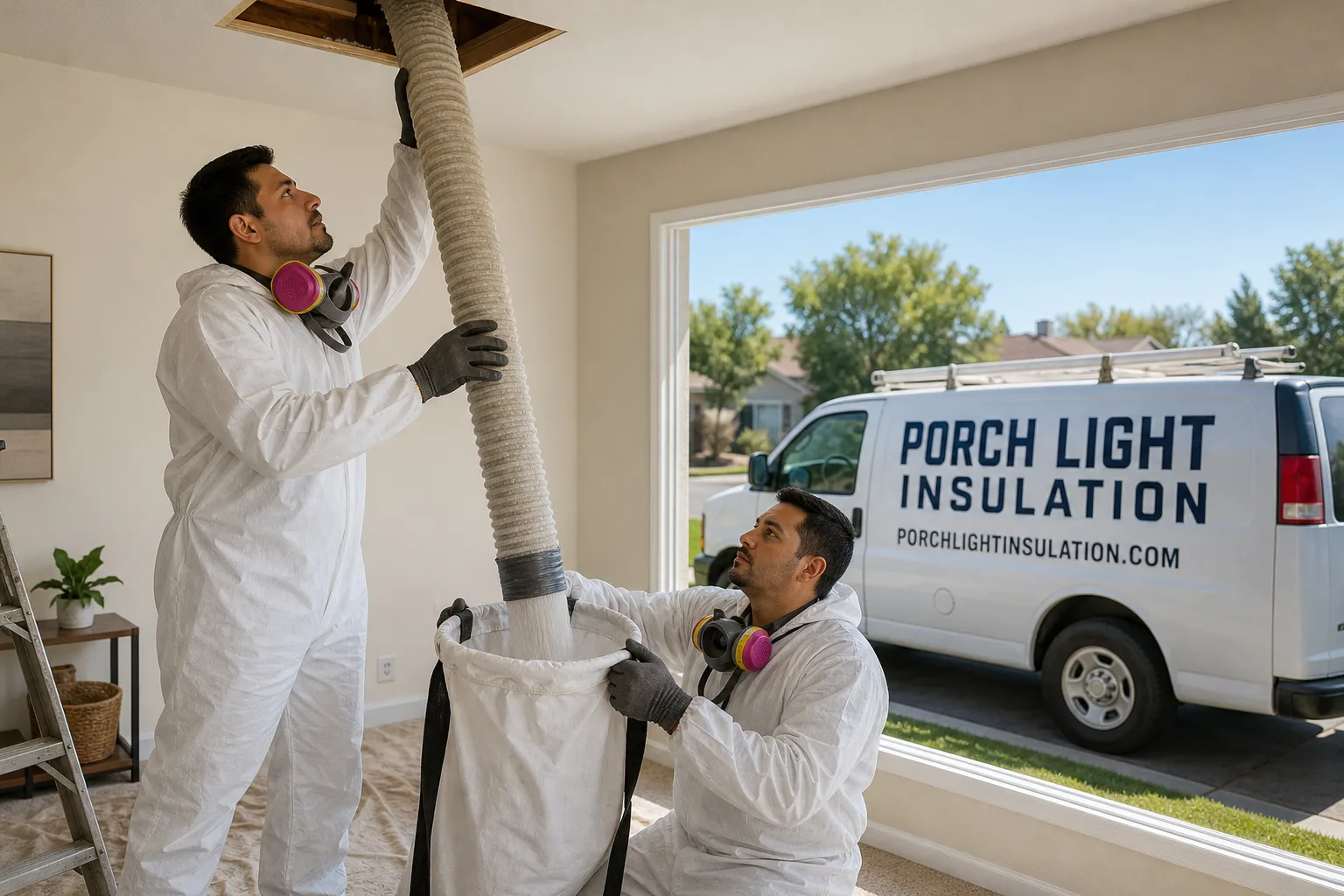
Fast, Reliable Attic Insulation Across Valley Glen
Most Valley Glen attics are losing the fight against San Fernando Valley heat. We’re talking 140°F+ attic temperatures in July and August, cooling systems running nonstop, and upstairs rooms that never quite catch up. Attic insulation in Valley Glen isn’t a winter project here. It’s a cooling-cost and comfort fix first, and Porch Light Insulation gets that. Gil Tanner and our crew work this area weekly, know the 1940s-to-1970s housing stock off Victory and Van Nuys boulevards, and can usually reach your Valley Glen home within a day or two. Call (877) 521-4987 for a free estimate that starts with an attic inspection, not a sales pitch.
Why Porch Light Insulation Is Valley Glen’s Preferred Attic Insulation Company
Insulation is all we do, which means it’s all we’ve mastered. That matters in Valley Glen because the attics here are not blank canvases. Many were insulated once in the 1960s or 1970s, then disturbed repeatedly by furnace swaps, rewiring, and duct retrofits. A general contractor who does insulation on the side won’t spot the bare patches and settled zones the way we do. Our estimators walk the attic, take photos, measure existing R-value, and only then recommend a number. Valley Glen homeowners appreciate that the quote matches what’s actually up there, not a guess based on square footage alone.
Gil Tanner founded Porch Light with a simple rule: match the material to the home, not to our inventory. That’s why we’re authorized to install from eight manufacturers, including CertainTeed, GreenFiber, Icynene, and Demilec. For a 1950s ranch in Valley Glen, that often means a blown-in fiberglass or cellulose top-up after air-sealing. For a newer two-story near the college, it might mean a radiant barrier under open-cell spray foam. We carry the breadth so you don’t get steered into whatever’s left on the truck.
Reputation in 91404 builds one attic at a time. Homeowners on Oxnard Street, Burbank Boulevard, and the neighborhoods west of the 170 tell their neighbors when a contractor actually documents the job. We do. Pre-upgrade photos, R-value readings, after photos. It’s part of the LADWP rebate paperwork, and it’s also how you know the job got done right.
Attic Ventilation in Valley Glen
Attic Ventilation matters more in Valley Glen than in most Los Angeles neighborhoods because our shallow, vented, post-WWII ranch attics trap heat in a way deeper modern attics don’t. A poorly ventilated Valley Glen attic can sit at 150°F or more from June through September, cooking the underside of your roof deck, baking your insulation, and pushing heat down into the living space below. Proper ventilation – balanced intake at the soffits and exhaust at the ridge or gable ends – moves that superheated air out before it radiates into your ceiling. We inspect existing vents, check for blocked soffits, and verify that any new insulation won’t choke the airflow path.
Vent and Baffle Retrofit
When we blow new insulation into a Valley Glen attic, the first step is confirming the eaves can still breathe. Decades-old vents get painted over during stucco re-coats, soffits get blocked by storage, and many original 1950s homes simply never had enough intake area. We install baffles against the roof sheathing to keep blown material from sealing off the soffit vents, then confirm the math: roughly one square foot of net free vent area per 300 square feet of attic floor. If the existing vents fall short, we’ll tell you before any insulation goes in.
When Ventilation Alone Fixes the Problem
Some Valley Glen homes don’t need more insulation yet – they need the heat out. If your attic already holds R-30 or better but the upstairs still bakes, the issue is often airflow, not thickness. A ventilation-only correction in Valley Glen typically runs $350 to $900 depending on the number of vents and baffles required. It’s a smaller job, but it changes the physics of the whole attic.
Radiant Barrier in Valley Glen
Radiant Barrier makes more sense in Valley Glen than in almost any other climate we serve, because our problem is radiant heat from the sun beating down on the roof, not conducted heat trying to escape upward in winter. A radiant barrier is a reflective foil layer installed along the underside of the roof rafters. It bounces radiant heat back out before it can soak into your attic air and your ceiling. In a 140°F Valley Glen attic, a properly installed radiant barrier can cut ceiling heat gain by a noticeable margin, which takes real load off the AC. For Valley Glen ranches with minimal attic depth, radiant barrier often delivers more comfort per dollar than adding another foot of blown-in material.
Foil Under the Rafters
The install involves stapling reflective foil to the underside of the roof deck or rafters, maintaining a small air gap that lets the foil do its job. We watch for can lights, ductwork, and the top plates where heat sneaks through. This is not a weekend DIY project in a 150°F attic, and we don’t recommend anyone try it in Valley Glen summer conditions. A mid-size one-story ranch here generally runs $1,200 to $2,800 depending on roof pitch and access.
Radiant Barrier With Blown-In Material
Most Valley Glen homes benefit most from doing both: a radiant barrier at the roofline and blown-in material on the attic floor. The barrier keeps heat from ever entering the attic mass, while the floor insulation slows what remains from reaching the ceiling. Combined on a typical 1,200-square-foot Valley Glen ranch, expect $2,400 to $4,800. It’s the approach we recommend most often in 91404, because it attacks the actual heat path instead of just adding thickness.
Trusted Brands We Service in Valley Glen
We install and service materials from eight manufacturers, and for Valley Glen specifically we keep certain product lines close at hand because they fit the housing stock. GreenFiber cellulose works well in older ranch attics with irregular joist spacing. CertainTeed blown-in fiberglass is a consistent performer in vented attics. And when the job calls for air-sealing and R-value in one pass, Icynene and Demilec open-cell spray foam handle it. We don’t stock parts and materials for one brand and force every Valley Glen home into it. Eight manufacturers, one goal: the right fit for your specific situation.
Common Attic Insulation Problems We See in Valley Glen Homes
- Settled original blown-in material. 1940s-to-1970s attics in Valley Glen often hold loose-fill that’s compacted to three or four inches, well short of today’s R-38 target. Decades of foot traffic from HVAC and electrical work strip zones bare entirely, leaving hot spots directly over bedrooms.
- Disturbed insulation around retrofits. A 1970s furnace replacement or a 1990s rewiring job usually means the original material was shoved aside and never put back. We see this constantly off Victory Boulevard and in the tract housing east of Van Nuys Boulevard.
- Unsealed top plates and can lights. Valley Glen ranches often have no air sealing between the living space and the attic. Air leaks at wall top plates, recessed lights, and duct penetrations let conditioned air rush into the attic year-round, making even fresh insulation underperform from day one.
- Shallow vented attics baking the house. Original 1950s stucco tract homes were built with minimal overhangs and passive vents barely adequate for full sun. Without a radiant barrier or ventilation correction, the attic becomes an oven that radiates heat down through the drywall for hours after sunset.
Pricing for Attic Insulation in Valley Glen, CA
A typical air-seal and blown-in top-up for a 1,200-square-foot Valley Glen ranch runs $1,800 to $3,500, depending on how much removal or leveling the old material needs first. Attic batt insulation in a 91404 home of similar size runs $2,000 to $4,000 when the old material has to come out first. Full attic insulation replacement, including removal, air sealing, and a radiant barrier, generally lands between $4,500 and $8,000. For smaller attics under 900 square feet, costs dip toward the low end. For two-story 1970s-era homes with limited access, expect the higher end. Call (877) 521-4987 and we’ll give you a specific number after walking the attic – estimates are free.
We Also Serve Cities Near Valley Glen
Our crews work the greater San Fernando Valley daily, and Valley Glen sits right in the middle of it. We regularly handle Attic Insulation jobs in Van Nuys, Sherman Oaks, Encino, and North Hills, often on the same week as Valley Glen appointments. If you’re on the edge of Valley Glen and a neighboring city, we’ll still come out.
Serving Valley Glen, CA — Our Local Coverage Area
We’re based in the Valley Glen area and know this community well. Use the map below to see our service coverage — if you’re nearby, we can almost certainly help.
FAQs About Attic Insulation in Valley Glen
Because LADWP wants proof that the work actually happened and hit the promised R-value. A photo of a bare attic followed by a photo of the same attic with new material at a documented depth is the core evidence. Skipped photos can forfeit the rebate entirely. We handle this documentation on every Valley Glen job, including before photos, R-value readings, and after photos, so your paperwork is complete the day we finish. Call (877) 521-4987 and we’ll walk you through the rebate process before we quote.
Never directly on top. The right sequence is inspection first, then air-sealing, then new material. On a 1950s stucco ranch off Victory Boulevard, our crew found the original insulation settled to about three inches and shoved aside around a 1970s furnace replacement, with a shallow vented attic baking past 140°F each summer. We sealed the top plates and penetrations first, then blew in GreenFiber to a documented R-value, photographing everything for the LADWP rebate. If we’d just blown new material over the old mess, the hot spots and air leaks would have stayed exactly where they were. So: yes, we top off, but only after the attic floor is properly sealed. Call (877) 521-4987 for an inspection.
Yes, and it’s one of the best investments for this specific climate. Radiant barrier works by reflecting the sun’s heat before it enters the attic, which is exactly the failure mode in a Valley Glen summer. Homes around Burbank Boulevard and Oxnard Street see ceiling temperatures drop noticeably after a proper foil install. Pair it with blown-in material and you attack both the radiant and conducted heat paths. Exact savings depend on your roof pitch and duct location, but the physics favors radiant barrier in 91404 more than most LA zip codes. Call (877) 521-4987 for a quote that includes it as a line item, not a mystery upgrade.
You measure the clearance at the eaves and check the vent path. If the soffit vents are blocked or the roof deck leaves less than a few inches of clearance at the edge, new insulation will choke the airflow and you’ll trade one problem for another. We check this on every Valley Glen estimate. If the vents are undersized, we quote baffles and additional vents as part of the job rather than pretending the insulation alone will hold. Most 1950s ranches in Valley Glen need some ventilation work as part of a proper retrofit. Call (877) 521-4987 and we’ll tell you what your specific attic needs after seeing it.
Title 24 already applies to any substantial roof or attic work in Valley Glen, and it sets insulation and cool-roof requirements that most pre-1978 homes don’t meet. If you’re re-roofing or doing a major renovation in 91404, the insulation portion of the project has to meet minimum R-values, and cool-roof materials may be required on the exterior. That doesn’t change the insulation install itself, but it does mean the attic work has to be documented and up to current code. We coordinate with your roofer on these Valley Glen projects so the insulation and roof work don’t conflict. Call (877) 521-4987 and mention Title 24 if you’re planning a roof alongside insulation.
Written by Gil Tanner, owner at Porch Light Insulation, serving Valley Glen and the San Fernando Valley since 2012.