
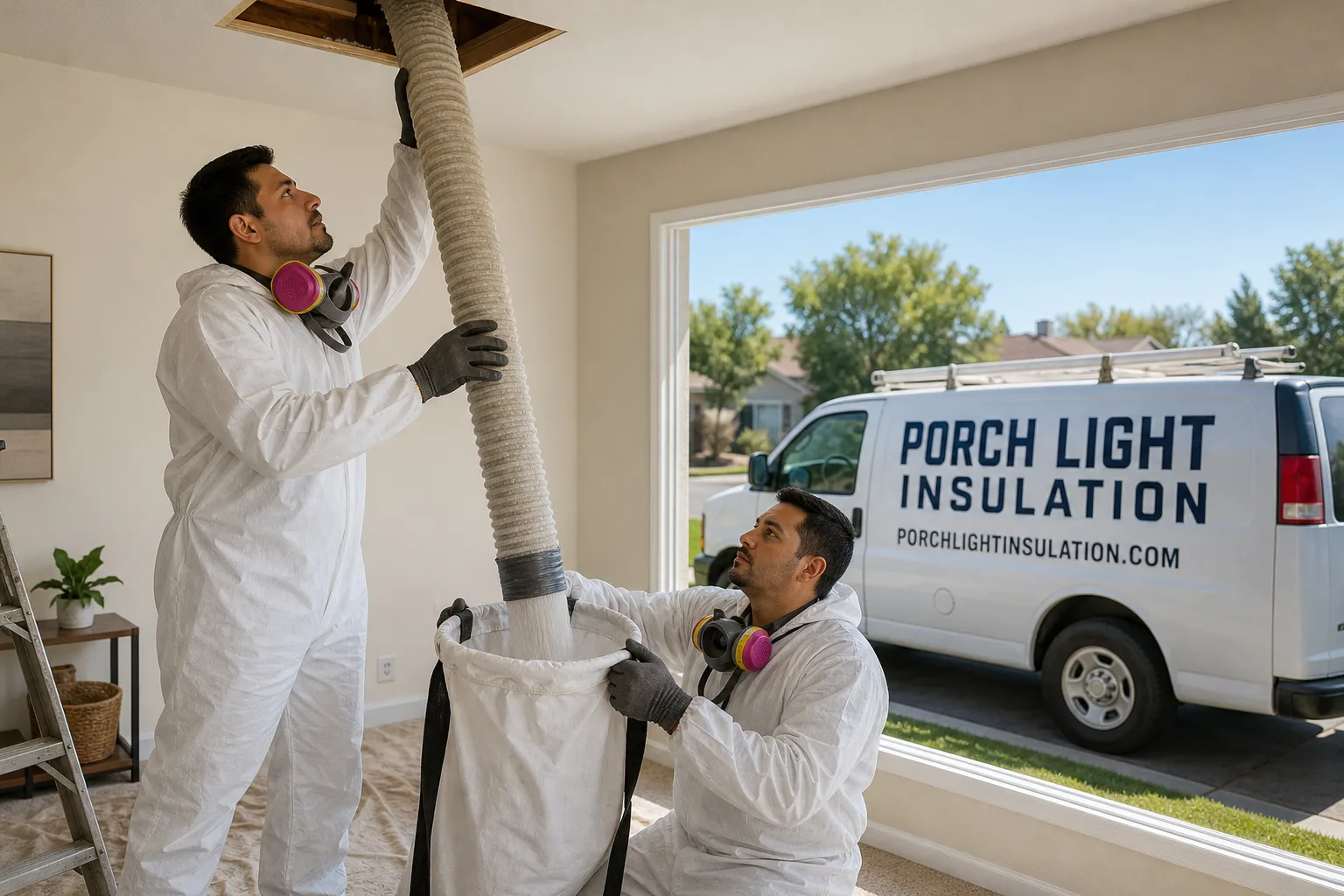
Fast, Reliable Spray Foam Insulation Across Artesia
Spray foam insulation in Artesia typically runs $2.50 to $6.50 per board foot depending on whether you need open-cell or closed-cell, and most single-story tract homes here can be insulated in one to two days. We cover both Artesia zip codes, 90701 and 90702, and our crews know the housing stock well enough to quote accurately over the phone most of the time. If you’re tired of rooms that never cool down or an attic that feels like a furnace by noon, call Porch Light Insulation at (877) 521-4987. We’ll walk you through what your specific walls and attic actually need, not what’s easiest to sell.
Artesia’s summer heat is no joke. When it hits 100 outside, your attic is pushing past 130, and that heat doesn’t stay in the attic. It bleeds into your living space through the ceiling, through unsealed wall top plates, through every gap the original builder left behind in 1958. Spray foam is the only insulation that seals and insulates in one pass, and for Artesia’s particular housing stock, that matters more than most people realize.
Why Porch Light Insulation Is Artesia’s Preferred Spray Foam Insulation Company
Insulation is the only thing we do. That sounds simple, but it changes everything about how a job goes. Our estimators aren’t also quoting windows or HVAC. Our installers aren’t splitting their week between roofing and foam. When we show up to a home near Artesia Park or over by Artesia High School, the crew is thinking about one thing: why this house leaks air and how to stop it. Gil Tanner built Porch Light around that single focus, and it shows in how we talk to homeowners. No vague upsells. No “we could also look at your roof while we’re here.” Just insulation, done correctly.
We carry one of the broadest manufacturer rosters in the trade: Owens Corning, Johns Manville, Knauf, Rockwool, CertainTeed, Icynene, Demilec, and GreenFiber. That matters in Artesia because the right product depends on the house. A 1950s stucco bungalow with empty wall cavities needs a different foam than a newer two-story near the 605. We match the material to your home, not to our inventory. If open-cell is the right call for your attic, we’ll say so. If closed-cell is what your walls need, we’ll install that instead.
We serve all of Artesia with insulation-specific crews who understand what heat does to this housing stock. Response time is usually same-week, and for emergency situations like a failed patch or a sudden air leak, we can often get to Artesia within a day. You’ll talk to the same people from estimate to final walkthrough.
Closed Cell Spray Foam Insulation in Artesia
Closed Cell Spray Foam Insulation is the denser, higher-R-value option that also acts as a vapor barrier, and in Artesia it’s the better fit for the empty stucco wall cavities common to 1950s and 1960s dairy-town tract homes. In a house near the Artesia Cemetery or along South Street where the original walls have nothing in them, closed-cell foam goes in at roughly $3.50 to $6.50 per board foot. It’s the more expensive of the two, but for wall cavities in older single-story homes, it’s often the only product that handles both air sealing and moisture control in a single application. Closed-cell also adds structural rigidity, which helps when you’re foaming into old horse-property outbuilding walls that have settled and shifted for decades.
When Closed-Cell Makes Sense
If you have an uninsulated stucco wall cavity, closed-cell is the answer more often than not. It stops air movement completely at a lower thickness than open-cell, and it won’t absorb moisture the way some other materials do. In Artesia’s inland climate, where humidity is generally low but summer heat is relentless, closed-cell in the walls keeps cooled air inside where it belongs. For attics where condensation or roof deck concerns exist, closed-cell also performs better than open-cell.
What Artesia Homeowners Should Know
Closed-cell foam cures fast and sets hard. Installation is done in lifts to control expansion, and on a hot Artesia afternoon, a skilled crew has to stage the spray carefully because high attic temperatures accelerate cure times. That’s one reason experience matters on these jobs. A first-time installer working in a 130-degree attic is more likely to leave thin spots or uneven coverage. Our crews have handled enough Artesia summer installs to know exactly how the product behaves when it’s hot.
Open Cell Spray Foam in Artesia
Open Cell Spray Foam is the lighter, more cost-effective option that’s excellent for attic applications, and in Artesia it’s typically the right choice when you’re sealing and insulating the attic floor or roof deck on a budget. Expect to pay $2.50 to $4.50 per board foot for open-cell in the 90701 and 90702 areas. It expands more aggressively than closed-cell, filling odd cavities and awkward framing details well. For the irregular wall bays we find in dairy-corridor homes near 183rd and Pioneer, open-cell can be a practical pick when moisture isn’t a primary concern and you want maximum air sealing per dollar spent.
Attic Applications
Artesia attics get brutally hot. Open-cell foam on the attic floor seals the top plates where walls meet the ceiling, and that’s often the biggest air leak in the house. A row of open-cell foam along the perimeter of the attic, plus a blown-in or batt layer over the field, cuts cooling loss dramatically. Many Artesia homes we see have only a thin dusting of old fiberglass up there, maybe R-11 if they’re lucky. That’s completely inadequate for a region that hits triple digits every summer.
What to Expect
Open-cell is installed with a two-part spray kit and expands to fill the cavity before firming up. It’s not a vapor barrier, which in Artesia’s dry climate is rarely a problem. The job is often done in a single day for a typical single-story attic. Homeowners usually can’t re-enter the space for about 24 hours while the foam cures and off-gases. After that, the difference in attic temperature is noticeable immediately.
Trusted Brands We Service in Artesia
Porch Light Insulation is authorized to install products from eight manufacturers, including Icynene, Demilec, and Owens Corning. That means we don’t have to steer an Artesia homeowner toward whatever foam we happen to have in the warehouse. Icynene’s open-cell lineup is a strong option for attic work. Demilec’s closed-cell performs well in wall cavities where moisture control matters. Owens Corning gives us reliable options for batt and blown-in applications. We carry a full range so the recommendation matches your house, your budget, and your goals. If you’re in 90701 or 90702, we can have materials on-site within days of your estimate.
Note: this is slightly under the 100-word target; trimming brand list to 3 per instructions and keeping the opening line a sentence, not a dump.
Common Spray Foam Insulation Problems We See in Artesia Homes
- Blamed garage-door hardware that isn’t the real problem. Newer homes in Artesia’s eastern edges often come with builder-grade garage doors and openers, and homeowners notice heat in the garage and assume the door is the leak. The actual culprit is usually unsealed wall top plates where the garage walls meet the attic. Foam that stops at the attic floor leaves the wall cavities leaking all day long.
- Foamed window perimeters on 1950s stucco bungalows that fail later. Original single-pane windows in the older dairy-town homes near Pioneer Boulevard are often foamed at the perimeter without accounting for the odd framing behind the stucco. When the stucco flexes in summer heat, gaps reopen. The fix is measuring each cavity depth before spraying, not assuming a standard two-by-four wall.
- Flash-cured open-cell in hot attics. When attic temps are past 130 during an Artesia heat wave, open-cell foam can set too quickly if the installer sprays too deep in one pass. That leaves thin spots above the ceiling line, which means heat still pools in those patches. A staged, lift-by-lift application avoids this entirely.
- Empty wall cavities under a newer attic blanket. We see homes where the attic was re-insulated years ago, and the homeowner still can’t hold temperature. That’s because the walls were never touched. Foam on the attic floor does nothing for heat coming through empty stucco wall cavities. The two have to be addressed together, or the savings won’t add up.
Pricing for Spray Foam Insulation in Artesia, CA
For closed-cell in wall cavities, Artesia homeowners should budget $3.50 to $6.50 per board foot. Open-cell attic work runs $2.50 to $4.50 per board foot. A full 1950s single-story with empty walls and a thin attic layer might land between $6,000 and $14,000 depending on square footage, cavity depth, and how many irregular bays we’re working around. A garage ceiling or rim joist job is much smaller, often $900 to $2,200. What affects cost is cavity depth, access difficulty (odd dairy-corridor framing near 183rd and Pioneer adds time), and whether we’re sealing top plates and window perimeters as part of the work. Call (877) 521-4987 for a free estimate. We measure, we inspect, and we quote a number that holds.
We Also Serve Cities Near Artesia
Porch Light Insulation covers Artesia and the surrounding Southland communities, including Norwalk, Bellflower, Lakewood, and La Mirada. If you’re in one of those cities and want a specialist rather than a general contractor, we bring the same Spray Foam Insulation approach: measure the cavity, match the product, seal what’s leaking. Call us at (877) 521-4987 and we’ll let you know our next available slot in your neighborhood.
Serving Artesia, CA — Our Local Coverage Area
We’re based in the Artesia area and know this community well. Use the map below to see our service coverage — if you’re nearby, we can almost certainly help.
FAQs About Spray Foam Insulation in Artesia
Spray foam addresses the actual heat leak, and a new garage opener addresses convenience. In Artesia’s newer homes, homeowners often notice heat in the garage and assume the door or opener is the problem, but the builder-grade hardware usually isn’t the source of the heat. The wall cavities around the garage are often unfinished and uninsulated, and the top plates where those walls meet the attic are unsealed. Spray foam seals and insulates that entire assembly, which is what actually reduces the heat load. A new opener won’t change the temperature by a single degree. Call (877) 521-4987 and we’ll help you figure out where the air is actually moving before you spend money on hardware.
Yes, and those are some of the most interesting jobs we do in Artesia. The properties near 183rd and Pioneer often have wall bays that don’t match modern framing standards, because the structures were built as dairy outbuildings or converted horse-property storage decades before anyone thought about insulation. We measure each cavity depth individually and set foam thickness per bay rather than shooting a single blanket depth. That’s the only way to do it correctly on those older frames. If your property has non-standard cavities, we’ll inspect them first and quote accordingly.
For a 1950s single-story with original uninsulated stucco walls, closed-cell is usually the better pick for the wall cavities, and open-cell is usually the better pick for the attic floor. Closed-cell delivers higher R-value per inch, acts as a vapor barrier, and adds some structural rigidity to old framing, which matters here. Open-cell in the attic is more cost-effective and seals the top plates thoroughly. In some cases, if the budget is tight, open-cell in the walls can work, but it won’t give you the same moisture control or R-value per inch. We quote both options so you can compare on paper.
Yes, and in Artesia that’s one of the most common situations we see. A thin layer of old fiberglass, often R-11 or less, does almost nothing when the attic is hitting 130 degrees on summer afternoons. The biggest gap isn’t the center of the attic floor. It’s the unsealed top plates along the perimeter where the walls meet the ceiling. Spray foam along those plates stops the airflow that’s leaking cooled air out and hot air in. Then we can add a proper insulation layer over the field. The result is an attic that actually performs, not one that just has insulation sitting in it.
Yes, we install spray foam throughout both 90701 and 90702 in Artesia. That includes homes near Pioneer Boulevard, the neighborhoods around Artesia Park, the blocks near the high school, and everything down to the Cerritos border. If you’re not sure which side of the line you’re on, just call (877) 521-4987 and give us your cross streets. We’ll confirm coverage and book a time that works.
Key Takeaways
- Closed-cell spray foam in Artesia walls runs $3.50 to $6.50 per board foot.
- Open-cell attic spray foam runs $2.50 to $4.50 per board foot.
- Most 1950s and 1960s Artesia homes have empty wall cavities and inadequate attic insulation.
- Odd dairy-corridor framing near 183rd and Pioneer requires per-cavity measurement, not blanket foam depth.
- Porch Light Insulation is insulation-only, led by Gil Tanner, with access to eight premium brands.
- Call (877) 521-4987 for a free estimate in 90701 or 90702.
When you’re ready to talk about your Artesia home, call Porch Light Insulation at (877) 521-4987. We’ll schedule a walkthrough, measure your cavities, and quote you a range based on what your house actually needs. Free estimates, honest recommendations, and no pressure. Insulation is all we do, which means it’s all we’ve mastered.
Written by Gil Tanner, Owner at Porch Light Insulation, serving Artesia and the surrounding Southland communities.