
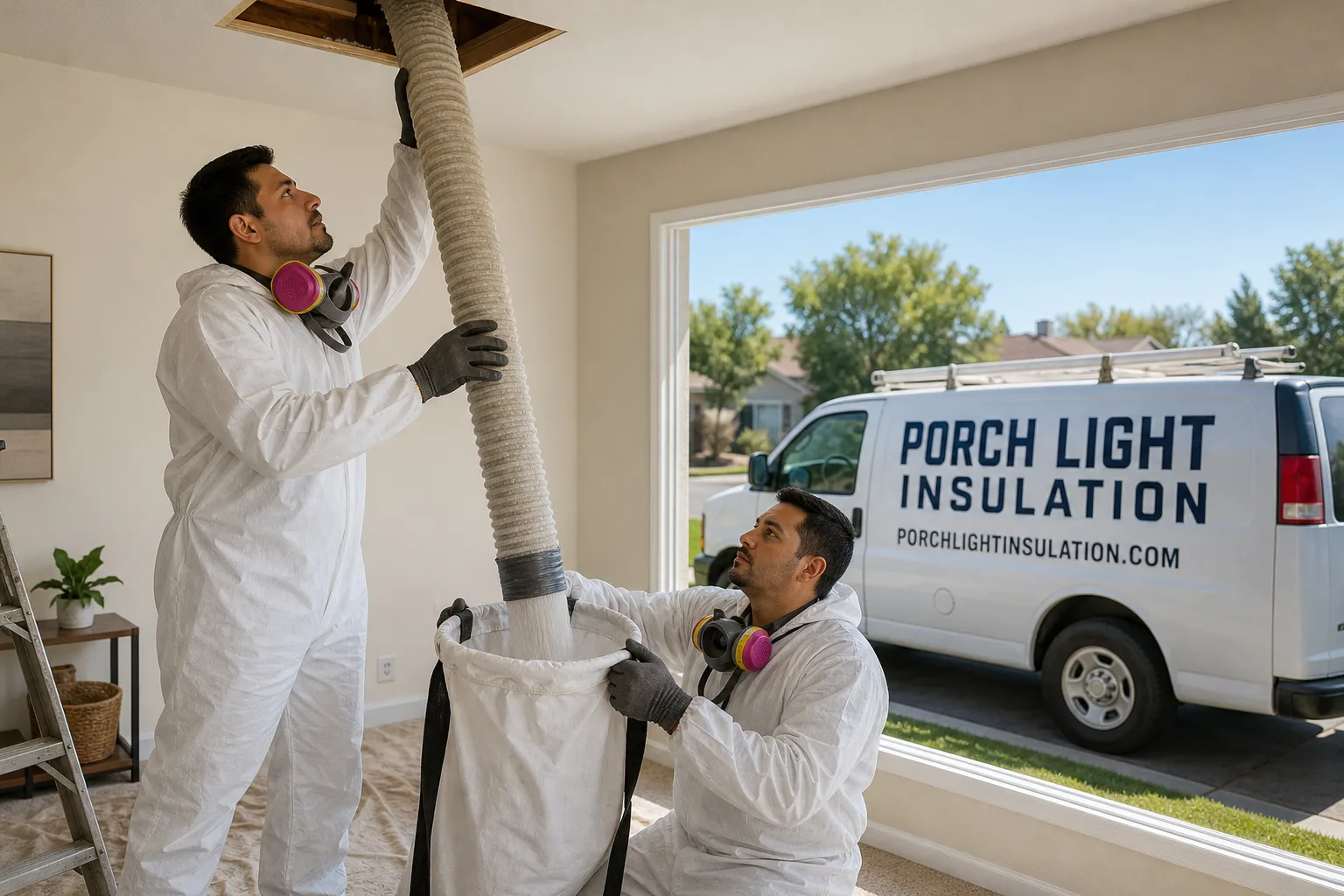
Fast, Reliable Spray Foam Insulation Across Lynwood
Spray foam insulation in Lynwood is almost always a targeted retrofit job, not a whole-house new-build application. Most homes here are 1950s and 60s stucco tract houses with empty wall cavities and attics that bake under the inland sun. When we get a call from a homeowner off Imperial Highway or Long Beach Boulevard, the problem is usually the same: upstairs or rear bedrooms that won’t hold temperature, and energy bills that climb every summer. Our crew knows these homes because we’ve been inside hundreds of them, and we can usually be at a Lynwood property the same day you call (877) 521-4987.
Why Porch Light Insulation Is Lynwood’s Preferred Spray Foam Insulation Company
We’re an insulation-only contractor, which means the estimator who comes to your Lynwood home, the crew that runs the hose, and the recommendation you get are all focused on one trade. That matters when the fix involves understanding how a stucco-on-frame wall cavity behaves differently than a wood-sheathed wall, or why a low-pitch roof deck in Lynwood holds heat the way it does. Gil Tanner and our team have walked through enough 90262 properties near Lynwood Park, the Civic Center area, and the neighborhoods south of the 105 to know which problems show up repeatedly in this housing stock.
Lynwood homeowners tell us the same thing over and over: they called a general contractor first, got a vague answer, then found us and got a direct one. Because insulation is all we do, we’re not splitting our attention across roofing or HVAC work. We’re matching the material to your home, not to whatever happens to be on our truck. And we show up when we say we will, which in this trade is rarer than it should be.
Spray Foam Attic Insulation in Lynwood
Spray Foam Attic Insulation in Lynwood typically costs $2,400 to $4,800 for a standard 1,000 – 1,400 square foot single-story tract home, depending on whether you choose open-cell or closed-cell foam and how much air sealing the attic needs. The job involves addressing the attic ceiling plane first: top plates, recessed can penetrations, wire chases, and the junction where the roof deck meets the walls. In Lynwood’s post-war homes, that junction is often a wide-open gap you could see daylight through, and it leaks conditioned air all year. Foam seals those gaps and adds an R-value layer that fiberglass batts simply cannot achieve in a low-pitch, cramped attic space.
The cooling load is what drives this work here. A mild, semi-arid climate means winter heat loss is a minor concern compared to what happens to an uninsulated attic in August when the sun beats on a dark composition shingle roof all afternoon. Attic temperatures in Lynwood can exceed 130 degrees on those days, and that heat radiates down through the ceiling into living spaces all evening. Foam stops that transfer at the source.
Top Plate and Penetration Sealing
The top plates on 1950s – 60s tract homes are where exterior walls meet the attic floor, and they’re usually unsealed. Warm interior air moves up through wall cavities and escapes into the attic, pulling hot outdoor air back in through the stucco walls. Closed-cell foam applied to the top plates stops this convective loop. It’s the single highest-leverage retrofit move in a Lynwood attic.
Roof Deck Edge Flashing
Lynwood’s low-pitch roof decks leave only a few inches of clearance at the eaves, which makes ventilation weak and air sealing difficult. We flash the roof-deck-to-wall junction with closed-cell foam from the attic side, sealing the edge where most of the heat enters. This is a specific fix for this housing stock, and it works.
Spray Foam Wall Insulation in Lynwood
Spray Foam Wall Insulation in Lynwood typically runs $1,800 to $3,600 for an exterior wall dense-pack or injection foam retrofit on a standard three-bedroom stucco home, depending on the number of cavities and whether we’re drilling through stucco or working from the interior. This is the most common wall job we do. The 1950s and 60s stucco tract homes around Lynwood were built with empty wall cavities, because nobody in 1957 thought a house in Los Angeles needed insulation. Now those same walls bake in the inland sun every afternoon, and rooms on the west and south sides of the house become unusable from 3 p.m. until after dark. Dense-packing or injecting spray foam into those cavities changes that.
Dense-packing through stucco means drilling small holes through the exterior finish, filling the cavity under pressure, and patching to blend. We do this on homes near Lynwood Park, along Imperial, and throughout the 90262 zip code. The result is a wall that actually resists heat transfer, which reduces the cooling load on your air conditioner. It also cuts outside noise, which matters on streets close to Long Beach Boulevard and the 105.
Stucco-On-Frame Cavity Filling
Stucco-on-frame construction has no exterior insulation and no sheathing that blocks air movement. The wall cavity is just an empty channel between the interior drywall and the stucco paper. Foam injected under low pressure fills that cavity completely, adhesively bonding to both surfaces. This stops the air movement that makes these walls feel hot to the touch in summer.
Sun-Facing Wall Priority
We recommend treating the sun-facing walls first. That means west-facing and south-facing walls, which take the direct inland sun from noon onward. The difference in a rear bedroom after the west wall is foamed is usually noticeable within the first hot week. Front rooms and shaded walls can be done later if the budget is tight.
Trusted Brands We Service in Lynwood
We install spray foam from Demilec, Icynene, and Owens Corning, and carry open-cell and closed-cell options so we’re not steering every Lynwood retrofit toward one product. Closed-cell foam is the usual choice for top plates, rim joists, and low-pitch roof deck edges because it adds structural rigidity and a vapor barrier in one pass. Open-cell is often the better value for interior wall cavities where air sealing matters more than maximum R-value per inch. We also stock GreenFiber loose-fill for attics where homeowners want a hybrid approach: cellulose over the flat areas, foam at the edges and penetrations. Eight manufacturers, one goal: the right fit for your specific situation.
Common Spray Foam Insulation Problems We See in Lynwood Homes
- Poor attic ventilation trapping moisture under the sheathing. Lynwood’s low-pitch roofs have minimal venting, and spraying closed-cell foam directly on the underside of a hot deck without addressing airflow can trap heat and condensation. We check ventilation first, and in many cases the right move is sealing the attic floor and leaving the roof deck alone.
- Skipping the wall cavities entirely. Some homeowners foam the attic and expect whole-house comfort, but the stucco walls on a west-facing Lynwood tract home still radiate heat. Attic work and wall work solve different problems, and the sun-facing walls need their own treatment.
- Hot-day application problems. Foam applied during a hot, dry Lynwood summer afternoon to a sun-baked stucco wall or roof deck can fail to adhere properly. Substrate temperature matters. We schedule Lynwood work for mornings or moderate days, and we monitor deck temperatures before spraying.
- Half-finished rim joist work. A previous contractor foams one section of the attic perimeter and walks away, leaving the rest open. Air doesn’t care about partial seals. We find and seal the entire perimeter, including the rim joists at the front and rear of the house where they meet the floor system.
Pricing for Spray Foam Insulation in Lynwood, CA
Spray foam insulation in Lynwood typically runs $1,800 to $4,800 depending on scope. A targeted top-plate and penetration sealing job on a smaller attic starts around $1,800 to $2,600. A full attic air seal with open-cell foam and a thermal barrier on a 1,200 square foot home runs $2,800 to $4,200. Closed-cell work on a low-pitch roof deck carries a premium because the material cost is higher and the preparation takes longer, typically $4,000 to $5,500 for an average Lynwood tract home. Wall cavity work runs $1,800 to $3,600 depending on how many sun-facing walls you treat. Call (877) 521-4987 for an exact quote on your home. Estimates are free, and we will tell you honestly if spray foam is not the right tool for your specific problem.
We Also Serve Cities Near Lynwood
Porch Light Insulation serves Lynwood and the surrounding communities of South Gate, East Rancho Dominguez, Willowbrook, and Paramount. If you’re east of the 710 or north of the 105 and need Spray Foam Insulation in Lynwood or a neighboring city, call us at (877) 521-4987. We schedule work across this part of the LA Basin throughout the week.
Serving Lynwood, CA — Our Local Coverage Area
We’re based in the Lynwood area and know this community well. Use the map below to see our service coverage — if you’re nearby, we can almost certainly help.
FAQs About Spray Foam Insulation in Lynwood
Because blown attic insulation alone does not air-seal the top plates, wall cavities, or the roof-deck edge, and those leaks are what make your stucco tract home uncomfortable in summer. Lynwood’s cooling load is driven by air movement and radiant heat, not just conduction. Foam stops the air movement. Blown fiber can’t. Call (877) 521-4987 and we’ll tell you which approach is right for your specific attic.
Yes. We dense-pack or inject foam through small holes drilled in the stucco exterior or through the interior drywall, not by removing the siding. The holes are patched to blend after the foam cures. This is the standard method for retrofitting empty wall cavities in Lynwood’s post-war tract housing, and we do it routinely.
It depends on where you put the foam. Sealing the attic floor and top plates is safe and effective. Spraying closed-cell directly on the underside of the roof deck on a poorly ventilated low-pitch roof can trap heat and moisture under the sheathing, which shortens the roof’s life. We’ll inspect your attic before recommending anything. If your roof deck is the problem, we’ll tell you, and sometimes the better fix is radiant barrier plus attic floor sealing. Call (877) 521-4987 for a straight answer.
It reduces both heating and cooling loss, but the Lynwood benefit is mostly cooling, since the warmer weather lasts nine months or more here. Spray foam keeps hot outside air from migrating through walls and ceilings into air-conditioned rooms. That means your AC runs less, bedrooms hold temperature through the afternoon, and summer bills drop. The winter benefit is real but secondary.
We install products from Demilec, Icynene, and Owens Corning, plus GreenFiber for hybrid cellulose-and-foam attic jobs. The brand matters less than choosing the right foam type for the application; we use open-cell for interior wall cavities and closed-cell for top plates, rim joists, and roof deck edges. We match the material to your home, not to our inventory.
Contact Porch Light Insulation in Lynwood
If your Lynwood home is too hot in the afternoon, if some rooms never hold temperature, or if your energy bill makes you wince every July, let’s talk. Call (877) 521-4987 for a free, no-pressure estimate. Someone who actually understands insulation will answer your questions and give you an honest recommendation. From blown-in attics to closed-cell spray foam, we compare options so you don’t have to guess.
Written by Gil Tanner, Owner at Porch Light Insulation, serving Lynwood and the surrounding Los Angeles Basin since 2015.