
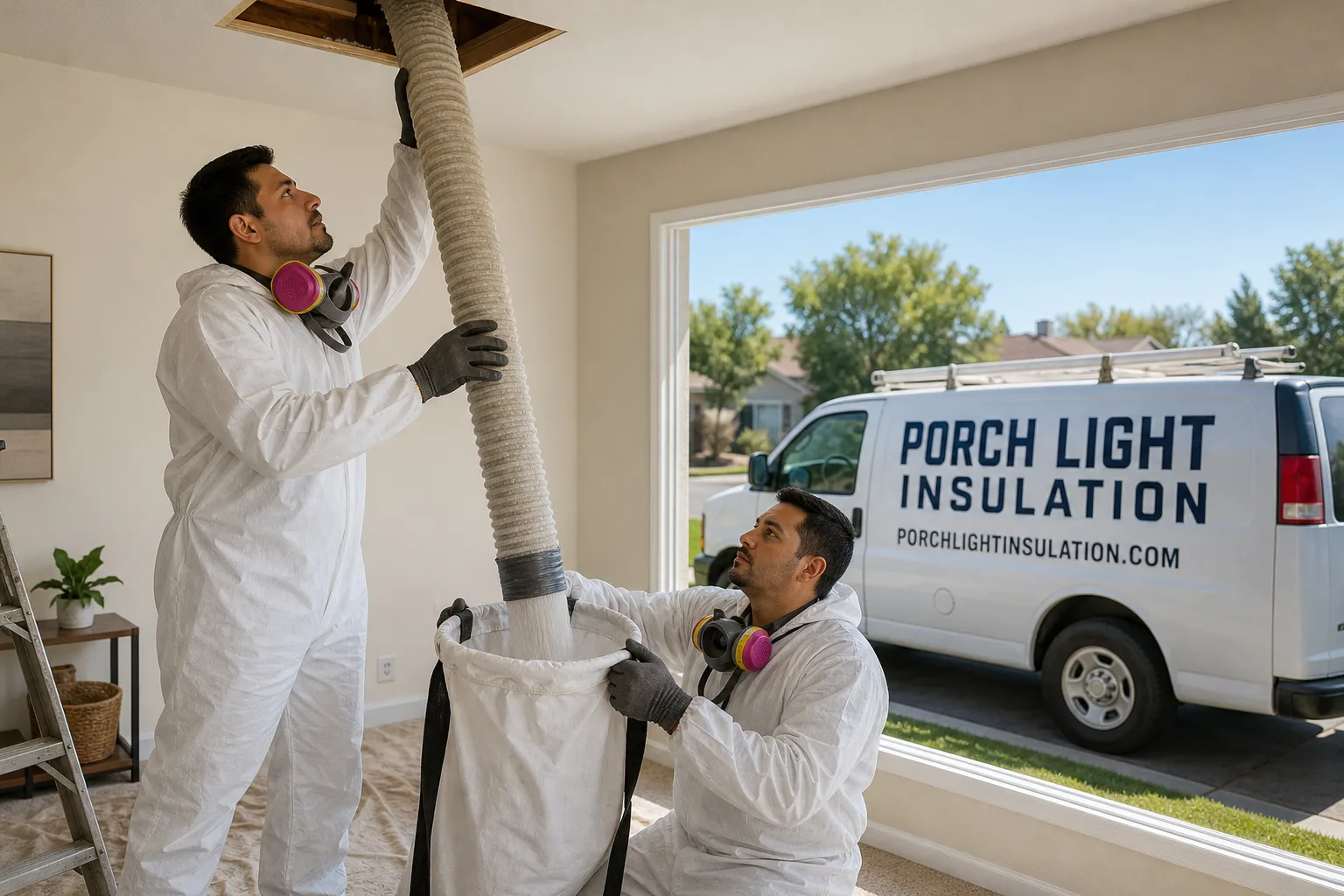
Fast, Reliable Spray Foam Insulation Across Whittier
Spray foam insulation in Whittier typically runs $2.50 – $7.00 per board foot installed, and for most homes here the real question isn’t whether foam helps, it’s where it goes. In the 1920s bungalows near Uptown, the answer is often the crawlspace and wall cavities. In the 1950s – 70s tracts of 90603 and 90604, it’s the attic. We’ve worked both patterns enough to know the difference, and we’ll tell you straight which one your house needs. Call (877) 521-4987 for a free estimate, and we’ll walk your home with you before quoting anything.
Why Porch Light Insulation Is Whittier’s Preferred Spray Foam Insulation Company
Insulation is the only thing we do. Not roofing, not HVAC, not remodeling. Every estimator, installer, and recommendation comes from years of working specifically with insulation systems, and that focus matters a lot in Whittier, where one block can have a 1930s California bungalow and the next a 1965 stucco tract house. The two need completely different approaches, and a generalist who installs insulation on the side isn’t going to catch the difference.
Our spray foam credentials cover both open-cell and closed-cell systems from Icynene and Demilec, backed by a product bench that also includes Owens Corning, Johns Manville, Knauf, Rockwool, CertainTeed, and GreenFiber. That’s eight manufacturers, one goal: the right fit for your specific situation. We match the material to your home, not to our inventory. Gil Tanner leads our team, and he’s spent years walking attics and crawls in the Los Angeles basin, including plenty right here in Whittier’s older core and the surrounding foothill neighborhoods. The single-trade focus means when we tell you something about air sealing or vapor control, it’s coming from an insulation specialist, not someone squeezing in foam between roof jobs.
Garage Spray Foam Insulation in Whittier
Garage spray foam insulation in Whittier is one of the most common retrofits we do, especially in the 90603 and 90604 tracts where attached garages with uninsulated ceilings and shared walls give off heat that makes the whole house warmer. A typical garage ceiling and wall foam job in Whittier runs $1,800 – $4,200 depending on square footage and whether it’s open-cell or closed-cell. If the garage is attached and the door faces west with no shade, that ceiling cavity becomes a heat sink by mid-afternoon, and the foam breaks that transfer.
Attached garages and the shared wall
Many Whittier garages share a wall with the living space. That wall is often just drywall over framing with no insulation at all. Closed-cell foam on that shared wall plus the garage ceiling cuts the heat migration into bedrooms and hallways. We see it consistently in the 1950s – 60s tract layouts where the garage sits at the front of the house and gets hammered by afternoon sun.
Detached garages and hobby spaces
Detached garages in Whittier are often used as workshops, gyms, or storage for temperature-sensitive items. Open-cell foam on the roof deck quiets the space and keeps it from turning into an oven. It also cuts the dust and pollen that pour in through vented soffits, which matters a lot under Whittier’s mature camphor trees.
Closed Cell Spray Foam Insulation in Whittier
Closed cell spray foam insulation in Whittier is the right call when you need structural strength, a vapor barrier, and the highest R-value per inch, all in one product. In Whittier’s older pier-and-beam homes, it’s the top choice for crawlspace walls and rim joists because it handles direct ground moisture far better than open-cell. A typical closed-cell rim joist and crawlspace wall job in Whittier runs $2,800 – $6,500. For attic roof decks, expect $3.50 – $7.00 per board foot.
Rim joists and crawlspace walls
We foamed the rim joists and crawlspace walls of a 1928 bungalow off Greenleaf near Uptown in 90601. The original open pier-and-beam foundation and no-insulation walls meant cold winter drafts and summer heat pouring up through the floor. Closed cell spray foam on the rim band and crawlspace walls sealed the balloon-frame bypasses and cut the floor-level drafts the homeowner had chased for years. That pier-and-beam construction typical of the older core makes the crawlspace the real air barrier, not the attic.
Roof decks and vaulted ceilings
The postwar tract homes in 90603 and 90604 have vented attics, but many Whittier homeowners want to convert that attic into a conditioned storage area or finish a vaulted ceiling. Closed-cell foam on the roof deck creates an unvented assembly that keeps the entire attic within the home’s thermal envelope. It’s a bigger job, but it changes how the whole top of the house performs.
Trusted Brands We Service in Whittier
We install spray foam from Icynene and Demilec, two premium lines we chose because they hold up in the Los Angeles basin’s heat better than budget foams. For fiberglass and mineral wool applications we stock Owens Corning, Johns Manville, Knauf, Rockwool, CertainTeed, and GreenFiber products. Eight manufacturers, one goal: matching the material to your Whittier home’s specific problem. Because we carry all of these lines, you don’t get steered toward whatever’s on the truck that day. You get what actually works for your crawlspace, attic, or garage. Our stocking includes fast-turnaround open-cell and closed-cell kits for Whittier jobs, so we’re not waiting on a distributor when your attic is already open.
Common Spray Foam Insulation Problems We See in Whittier Homes
- Closed-cell foam sprayed over failed attic batts. In the 1950s – 70s stucco tracts of 90603 and 90604, the original fiberglass batts are often compressed, rodent-disturbed, and packed with decades of dust. Foaming directly over them traps debris and moisture instead of correcting the failed assembly. The batts have to come out first.
- Attic-only foam on 1920s – 1940s bungalows. In 90601 and 90602, the real air leak isn’t the attic, it’s the balloon-framed walls and the open crawlspace. A one-size attic foam job leaves the dominant air loss unaddressed, and the homeowner wonders why the floors are still cold. The crawlspace has to be part of the conversation.
- Crawlspace foaming without vegetation planning. The mature camphor and citrus trees over the older Whittier blocks drop debris and shade that change attic and crawlspace ventilation. Foaming a pier-and-beam crawlspace without accounting for that shade can create condensation risk at the rim band. We assess the tree cover and venting before we spray.
- Garage ceilings ignored on west-facing attached garages. Whittier sun hits west-facing garage doors hard from about 2 p.m. onward. Homeowners chase comfort with HVAC upgrades when the real issue is an uninsulated garage ceiling baking the rooms above and beside it. Foam the ceiling, and the HVAC finally keeps up.
Pricing for Spray Foam Insulation in Whittier, CA
Here are the honest numbers for Whittier. Open-cell spray foam runs $0.45 – $0.85 per board foot for materials, and $2.00 – $3.50 per board foot installed. Closed-cell runs $1.00 – $1.50 per board foot for materials, and $2.50 – $7.00 per board foot installed. A crawlspace rim joist and wall job in the older 90601 core typically lands between $2,800 and $6,500. A full attic roof deck in a 1,400-square-foot tract home runs $4,500 – $9,000. Square footage, access, prep work on failed existing insulation, and the condition of framing and sheathing all move the number. Call (877) 521-4987 and we’ll give you an exact quote after looking at your home. Estimates are free.
We Also Serve Cities Near Whittier
Our Spray Foam Insulation team works throughout the San Gabriel Valley and the Gateway Cities. Beyond Whittier, we regularly install spray foam in South Whittier, West Whittier-Los Nietos, Santa Fe Springs, and Pico Rivera. If you’re on the edge of 90601 or 90603 and aren’t sure which service area you fall into, call and ask.
Serving Whittier, CA — Our Local Coverage Area
We’re based in the Whittier area and know this community well. Use the map below to see our service coverage — if you’re nearby, we can almost certainly help.
FAQs About Spray Foam Insulation in Whittier
In your home, the spray foam goes into the crawlspace first: the rim joist band, the crawlspace walls, and the gaps where balloon-framed wall cavities meet the floor system. That seals the dominant air leak path and cuts the drafts and heat coming up through your floors. The walls can then be foamed from either the interior during a remodel or from the exterior before new siding goes on. The attic is secondary in your house, not primary.
Because the original fiberglass batts in those vented attics have been there for 50 to 70 years. They’re compressed from foot traffic, chewed through by rodents, and coated with dust so they don’t perform anywhere near their original R-value. The attic looks insulated but behaves like an uninsulated space, radiating heat into the house. Closed-cell foam on the roof deck or proper air sealing plus fresh blown-in insulation fixes it, but the old batts have to come out first. Call (877) 521-4987 for a free look at what’s actually in your attic.
Yes. Mature camphor and citrus trees over the 90601 and 90602 blocks cool roof-surface temperatures, which sounds good but slows the drying of any trapped moisture in the attic assembly. When we spray foam an attic in those neighborhoods, we check the ventilation and roof sheathing condition first. The shade means condensation risk is higher if the foam goes in over damp or fungus-stained sheathing, so prep matters more here than in full-sun tracts.
For an attached garage that shares a wall with your living space or sits under bedrooms, closed cell is usually the right call. It adds structural strength to the ceiling, blocks vapor movement, and gives you the highest R-value per inch in a space where every inch of headroom matters. For a detached garage that’s only used for parking and light storage, open-cell foam on the roof deck is often enough and costs about half as much. We’ll show you both numbers before you pick.
We install open-cell and closed-cell spray foam from Icynene and Demilec, and we’re authorized to install products from Owens Corning, Johns Manville, Knauf, Rockwool, CertainTeed, and GreenFiber for fiberglass, mineral wool, and loose-fill work. We carry all of them so the recommendation matches your home’s needs, not our inventory. Eight manufacturers, one specialist.
If your Whittier home is drafty, hot upstairs, or burning through energy in the crawlspace, call (877) 521-4987 for a free estimate. We’ll come out, look at what’s actually in your attic, walls, and crawlspace, and give you a straight answer with real numbers. Written by Gil Tanner, Owner at Porch Light Insulation, serving Whittier and the surrounding area.