Johns Manville Attic Insulation in Universal City: A Homeowner’s Guide
Johns Manville makes three distinct attic insulation products for three different attic situations in Universal City: Climate Pro blown-in fiberglass, Spider spray-applied fiberglass, and traditional fiberglass batts. Choosing the wrong one for your attic type usually means paying for R-value you’ll never actually get. If you’d rather not sort through coverage charts and settled-depth math on your own, call (877) 521-4987 and we’ll match the right JM product to your specific attic.
Specifying “Johns Manville insulation” is a bit like ordering “a Toyota”: the brand is reliable, but a Tacoma and a Camry are very different tools for different jobs. The same gap in precision sends plenty of Universal City homeowners home with the wrong JM product for their attic. This guide sorts out which Johns Manville line actually fits your house, your roof framing, and the way heat behaves in a San Fernando Valley summer.
Key Takeaways
- Climate Pro is the workhorse for flat attic floors with standard framing; Spider is for open rafter bays, cathedral ceilings, and knee walls.
- Universal City’s cooling-dominated climate means attic R-value matters more for keeping heat out than keeping heat in.
- JM’s own installation instructions require air sealing before blowing. Skipping that step quietly guts your performance.
- The settled R-value on the coverage chart is the number that matters, not the fluffy installed thickness.
- Several JM fiberglass products use borate-based formulations that deter pests, a genuine benefit for hillside homes in Universal City.
Why “Johns Manville Insulation” Isn’t One Thing
Johns Manville has been making insulation since 1858, and today the company ships three product families that routinely show up in Universal City attics. Each one exists for a different construction condition, and treating them as interchangeable is the most common mistake we see on older and mid-century homes in the area.
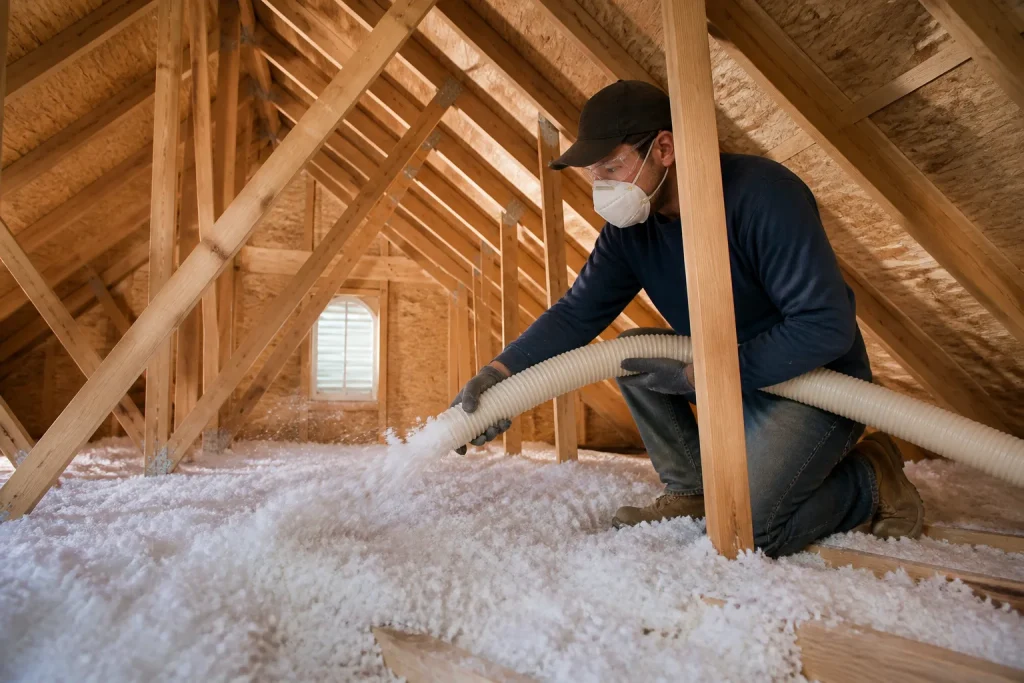
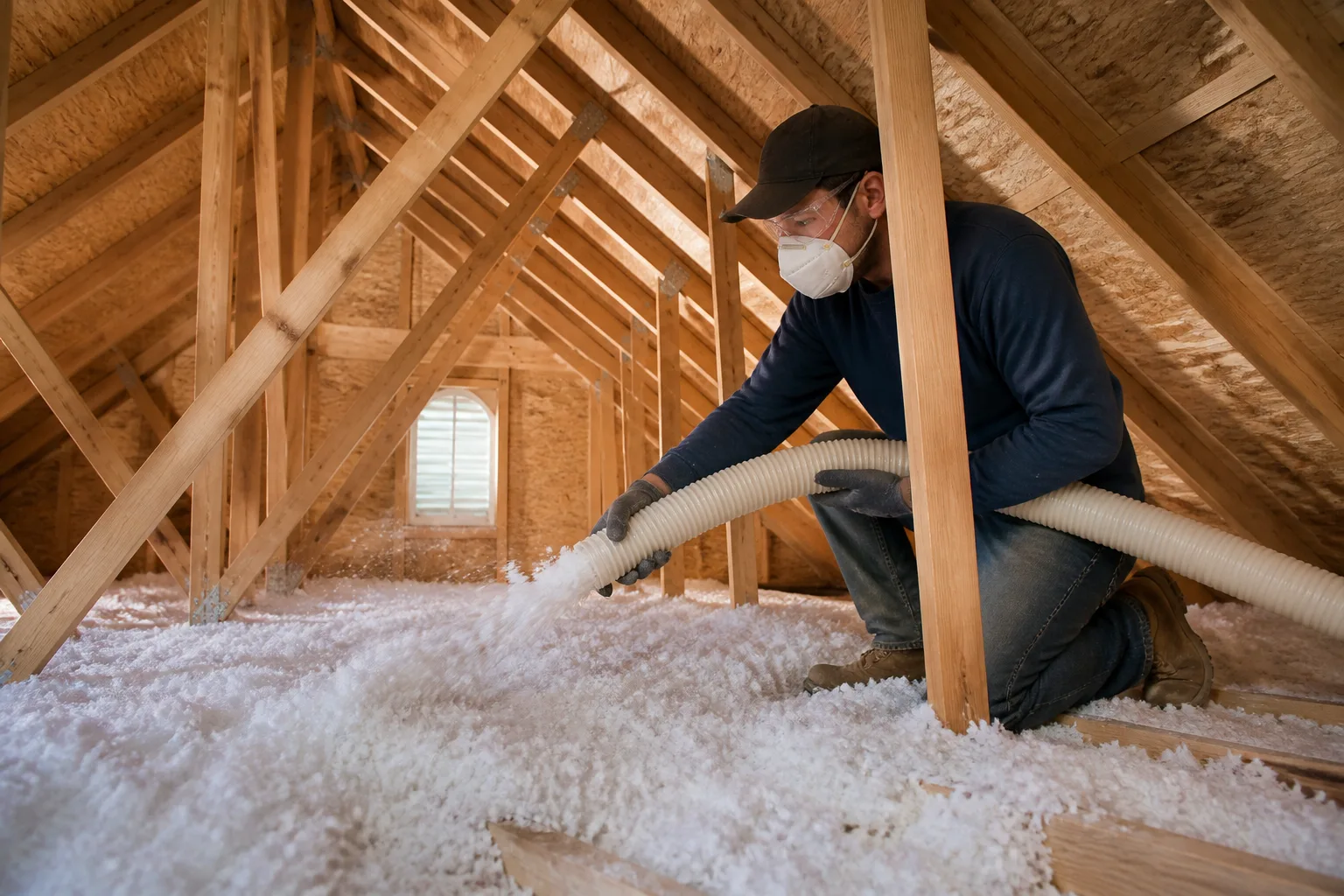
Climate Pro is a loose-fill blown fiberglass designed to blanket flat attic floors. It settles at a predictable rate, and the coverage chart on every bag tells you exactly how many bags a given square footage needs to hit a target R-value at a given depth. This is what most Universal City ranch homes and 1960s to 1970s tract houses should have in their attics.
Spider is a spray-applied fiberglass system that uses a water-based adhesive to bond the fibers into open cavities like rafter bays, cathedral ceilings, and the angled sections of bonus rooms. It does not fall out, does not settle in the wall, and reaches places loose-fill can’t. If you have a hillside home in Universal City with a vaulted ceiling over the living room, Spider is most likely the correct JM product.
JM batts are pre-cut fiberglass blankets for standard 16-inch and 24-inch framing cavities. They’re fine for new construction and certain wall applications, but in attics they are easy to cut short or compress around obstructions, which costs you meaningful R-value even in cooling-dominated Universal City summers.
One thing all three share: they are all fiberglass. If you want mineral wool or spray foam instead, we’ll bring brands like Rockwool or Icynene into the conversation. This is exactly why we carry multiple manufacturers: we match the material to your home, not to our inventory.
Climate Pro in Universal City: What the Coverage Chart Actually Tells You
Climate Pro delivers roughly R-2.9 to R-3.4 per inch depending on density and settled depth. That number matters a lot in Universal City attics with limited clearance. Plenty of mid-century homes in the area were framed for shallow insulation, with ceiling joists only 2×6 or 2×8 deep. If your attic has 6 inches of total joist depth, you cannot physically fit enough loose-fill to reach modern code R-49 without building up the framing or accepting a lower target.
Here’s the basic settled-depth math for Climate Pro at common Universal City targets:
- R-30: roughly 10 to 11 inches of settled product
- R-38: roughly 12 to 13 inches of settled product
- R-49: roughly 16 to 17 inches of settled product, which exceeds the depth of a 2×8 joist bay
The coverage chart exists for a reason. A proper JM installation quote should include the square footage of the attic floor, the number of bags that footprint requires at the target R-value, and the minimum settled depth the installer will verify with a ruler after blowing. Quotes that just say “blow in R-38” without bag counts or depth verification are shorthand we’d encourage any Universal City homeowner to question.
The settled number is the honest number. Blown fiberglass goes in fluffy and settles over weeks to months. An installer who measures depth immediately after blowing, before settling, is measuring a number that will not be there in August. That August number is the one that actually cools your house.
Spider for Cathedral Ceilings and Hillside Homes
A large share of Universal City homes sit on slopes, and slope means structural variety: split levels, daylight basements, upper-floor rooms tucked into rooflines, and cathedral ceilings over main living areas. Loose-fill cannot go into a sloped or vertical cavity. It simply falls to the bottom and leaves the upper section of every rafter bay uninsulated, which turns those angled ceilings into heat radiators from May through October.
JM Spider is designed for this condition. The fiberglass is blown dry into open cavities along with an adhesive mist that bonds the fibers together and to the framing. It fills odd rafter bay shapes fully, stays put, and does not settle over time. The material delivers roughly R-3.5 to R-3.8 per inch, which is slightly better than loose-fill and close to dense-packed performance in a cavity application.
One practical note from jobs we’ve worked on around Universal City: Spider requires open access to the back side of the insulation plane. That means for cathedral ceilings, the installer needs to remove the drywall, or the home needs to be under construction with open framing. In a retrofit, covering Spider with new drywall is part of the scope. This is why the method comparison matters up front. If opening a ceiling isn’t acceptable, a closed-cell spray foam like Icynene can be installed through small access holes instead, and we’ve had that conversation with plenty of Universal City homeowners sorting through their options.
For more on how spray foam compares in Universal City attics, see our guide to Spray Foam Insulation in Universal City.
Air Sealing First: The Step Most Roofers Skip
Johns Manville’s own installation guidance for blown attic insulation says plainly that the attic floor should be air sealed before the loose-fill goes in. This is not optional fine print. Air sealing closes the gaps around wiring penetrations, recessed can lights, plumbing vents, and the top plates of interior walls, and these gaps are how conditioned air escapes into the attic and how 120-degree attic air gets pulled into the living space.
In a Universal City summer, the temperature difference between a conditioned house at 74 degrees and an unventilated attic at 130 degrees is enormous. Any leak between those two zones turns your insulation into a filter, not a barrier. Air moves through fiberglass. Fiberglass is a thermal blanket, not an air barrier, and it was never designed to stop airflow. The R-value on the bag assumes still air, and a leaky attic floor guarantees moving air.
Sealed, then blown, in that order, is the only installation sequence that produces the rated performance. Some contractors skip the sealing step because it adds time and ladder work before the loud blowing begins. A homeowner would never know they skipped it from the look of the finished attic, because the insulation covers everything. You only find out on the first heat wave when the upstairs still won’t hold temperature, and by then the insulation is buried and the fix costs more.
This is the single biggest miss we find in existing attics around Universal City: plenty of blown fiberglass, some of it only a few years old, installed over a leaky attic floor. The product was fine. The sequence was wrong. Sealing before blowing is a manufacturer requirement, not an upsell.
Borate Formulation and Pest Pressure in Hillside Homes
Several Johns Manville fiberglass products, including Climate Pro, use a borate-based formulation in the fiberglass itself. Borate is the same family of compounds used in some termite treatments and wood preservatives, and it functions as a deterrent rather than a pesticide. The material does not attract pests and makes the attic environment less hospitable to insects that might otherwise nest in the insulation.
This matters in Universal City because the hillside neighborhoods that climb toward Mulholland and the Santa Monica Mountains sit directly against open parkland and chaparral. Rats and roof rats are a regular presence in the area’s attics, especially in older homes with unsealed eave gaps and accessible return-air chases. We pulled one out of a garage over in the hills near Barham Boulevard last month where the homeowner had been hearing chewing above the master bedroom for weeks.
Borate-treated fiberglass is not a rodent-proofing measure by itself, and we say that clearly to every homeowner who asks. Rats and mice will tunnel through any fibrous insulation if they find a way into the attic. But a borate-treated product reduces insect activity and removes one attraction for pests, especially when paired with proper air sealing and pest exclusion at the exterior. For hillside Universal City properties, we typically recommend the borate-formulated JM line as part of a broader attic strategy that includes sealing entry points before blowing. If fire resistance is a priority for you given the brush-adjacent landscape, Rockwool mineral wool is worth discussing instead. It’s a material most insulation contractors don’t even carry, and it changes the conversation around both fire and sound performance. We keep it on the truck because some houses genuinely need it.
How to Read a Johns Manville Installation Quote in Universal City
If you’re gathering attic insulation quotes in Universal City, you’ll get a range of line items, bag counts, and R-value targets. Some of them will be written to generate a phone call, and some will be written to produce a correct attic. Here’s what separates the two.
A credible JM quote includes these items:
- Square footage of the attic floor or cavity area, not of the house footprint. An attic is never the same square footage as the conditioned floor plan below it.
- Bag count by climate zone. For Universal City, the manufacturer chart will show bags per 1,000 square feet at the target R-value for the Southern California climate zone. If the bag count is missing, ask for it.
- Installed depth, not initial blown depth. The settled minimum should be measured and written down, with a tolerance, not eyeballed.
- Air sealing scope. If the quote doesn’t include sealing of top plates, penetrations, and recessed light enclosures before blowing, the insulation portion is incomplete by the manufacturer’s own guidance.
- Access and prep conditions. Older Universal City attics often have vermiculite present, knob-and-tube remnants, or previous blown material that needs removal first. A quote that ignores what’s already up there cannot be accurately priced.
A quote that just says “blow R-38, includes labor” without square footage, bags, depth verification, or sealing is not a specification. It’s a price. You can’t compare one price to another when neither describes the same job, which is exactly how the wrong product ends up in the right house.
When to call a pro: any time the attic contains vermiculite, which requires professional testing and handling, or when you’re not sure whether the existing insulation is still performing. Fiberglass that’s been walked on, soaked by a roof leak, or buried in rodent debris has lost meaningful R-value and should be removed, not topped off. A trained eye sees that in about ten minutes.
Related services in Universal City: if blown-in fiberglass turns out not to fit your attic type, read our guides to Attic Insulation in Universal City and Blown In Insulation in Universal City. If you’re comparing foam against fiberglass entirely, start with our Porch Light Insulation home page for a plain-language overview of all three methods.
The Bottom Line
Johns Manville makes good insulation, but the brand name alone doesn’t tell you which of its three attic product lines belongs in your Universal City home. Climate Pro suits flat attic floors where depth is available and air sealing is done properly first. Spider suits sloped and cathedral ceilings where batting and blowing both fall short. Batts have their place in standard framing but lose badly in retrofit attics. The right product is a function of your attic’s geometry, your home’s age, and whether your installer treats air sealing as step one. If you’re in Universal City and want a clear recommendation based on your actual attic, not a brand preference, Porch Light Insulation offers free estimates. Call (877) 521-4987 and we’ll walk the space with you before we quote a single bag.
Frequently Asked Questions
For a typical Universal City home, blown-in Climate Pro attic insulation runs roughly $1.50 to $3.00 per square foot installed, depending on target R-value, access conditions, and whether air sealing and removal of old insulation are included. Spider runs higher due to the spray equipment and the adhesive system. Call (877) 521-4987 for an exact quote; estimates are free and based on your actual attic, not a generic square-foot multiplier.
Yes, when installed at the proper settled depth over a sealed attic floor. Climate Pro at R-38 or higher meaningfully slows the heat gain that pushes down through your ceiling in August. The product itself is not the weak link; skipped air sealing and under-blown depth are what kill performance in Universal City homes.
In many Universal City attics, yes. A typical blown-in Climate Pro job on a ranch or tract home takes a single day, including air sealing and depth verification. Larger attics, cathedral ceiling work with Spider, or attics requiring old insulation removal will run longer. Call (877) 521-4987 and we’ll give you a realistic time window for your specific house.
Replacing often costs more up front but is usually the better value when existing insulation is compressed, contaminated, or below R-30. Topping off old fiberglass without addressing air sealing or existing moisture problems just adds another layer over the same leaks. A proper attic assessment takes one visit and tells you whether adding, removing, or starting over gives you the most R-value per dollar.
Written by the team at Porch Light Insulation, serving Universal City since 2014.
Need Insulation Help?
Call Porch Light Insulation — licensed & insured, here with fast after-hours help in Universal City.
(877) 521-4987