
Fast, Reliable Spray Foam Insulation Across Universal City
Spray foam insulation in Universal City is a different animal than what you’ll find in Studio City or North Hollywood. Here, the work centers on soundstages, production offices, theme-park facilities, and hospitality buildings, not residential attics. Acoustic control and heat resistance are the priorities, and most of these structures are large, metal-framed, and decades old. Our crews know the backlot, the hotel corridor off Lankershim, and the production buildings along Universal Hollywood Drive. If you’re managing a facility that’s bleeding noise or fighting heat gain, call (877) 521-4987 for a free estimate, and we’ll put a specialist on it fast.
Why Porch Light Insulation Is Universal City’s Preferred Spray Foam Insulation Company
Porch Light Insulation is an insulation-only contractor. That’s not a tagline, it’s our entire operating model. We don’t split crews between roofing, HVAC, and insulation jobs, which means every estimator, installer, and recommendation we make comes from someone who thinks about building science all day. In Universal City, that matters. Facility managers on the backlot don’t need a generalist. They need someone who understands why a 1970s metal-framed soundstage will degrade foam differently than a wood-framed rental in the Valley.
We carry one of the broadest manufacturer rosters in the trade, including Icynene, Demilec, Owens Corning, and GreenFiber. That matters because Universal City projects often require acoustic open-cell foam, high-R-value closed-cell foam, or radiant-barrier-compatible spray foam, and sometimes all three across adjacent buildings. We match the material to the building, not to our inventory.
Run by Gil Tanner, Porch Light Insulation approaches every Universal City job with the same question first: what is this structure actually doing, and what’s the failure mode? That’s how you get to the right answer instead of the convenient one.
Open Cell Spray Foam in Universal City
Open Cell Spray Foam in Universal City is the workhorse for acoustic isolation in metal-framed soundstages and production buildings. Open-cell foam expands aggressively to fill irregular wall cavities, brick ledges, and gaps between steel framing members. It has a lower R-value per inch than closed-cell (roughly R-3.5 per inch versus R-6.5), but it’s the material to reach for when sound damping is the main goal. It absorbs airborne noise rather than reflecting it, which is exactly what you want when a tram tour rolls past every 20 minutes.
A typical open-cell spray foam application in a Universal City soundstage wall runs $1.40 to $2.25 per board foot, installed. For a 1,500-square-foot wall at a nominal 3.5 inches of depth, that’s roughly $7,300 to $11,800 before any access or prep work. Job conditions drive the final number. If the original insulation has reached “dust and degraded fiberglass” status, removal and disposal adds cost.
Acoustic Sealing in Metal-Framed Buildings
Metal framing conducts sound. A steel stud transfers vibration down its entire length, so foam applied only between studs will fall short. On backlot work, we specify open-cell foam installed as a continuous airtight layer, filling the cavity completely so the stud itself gets encased. That breaks the vibration path.
We also detail perimeter gaps where the slab meets the wall. These gaps can carry low-frequency noise from nearby equipment and are often overlooked. Sealing them with open-cell foam is simple, effective, and inexpensive in the context of a production schedule.
When Open Cell Makes More Sense Than Closed
Open-cell foam is not the right choice for exterior walls in a humid or wet assembly. It allows vapor to pass through. But in Universal City’s dry climate, and in interior soundstage walls where there’s no moisture drive, open-cell gives excellent acoustic performance for less money than closed-cell. It’s also lighter, which helps when dealing with older framing that’s already carrying decades of load.
Spray Foam Insulation Contractors in Universal City
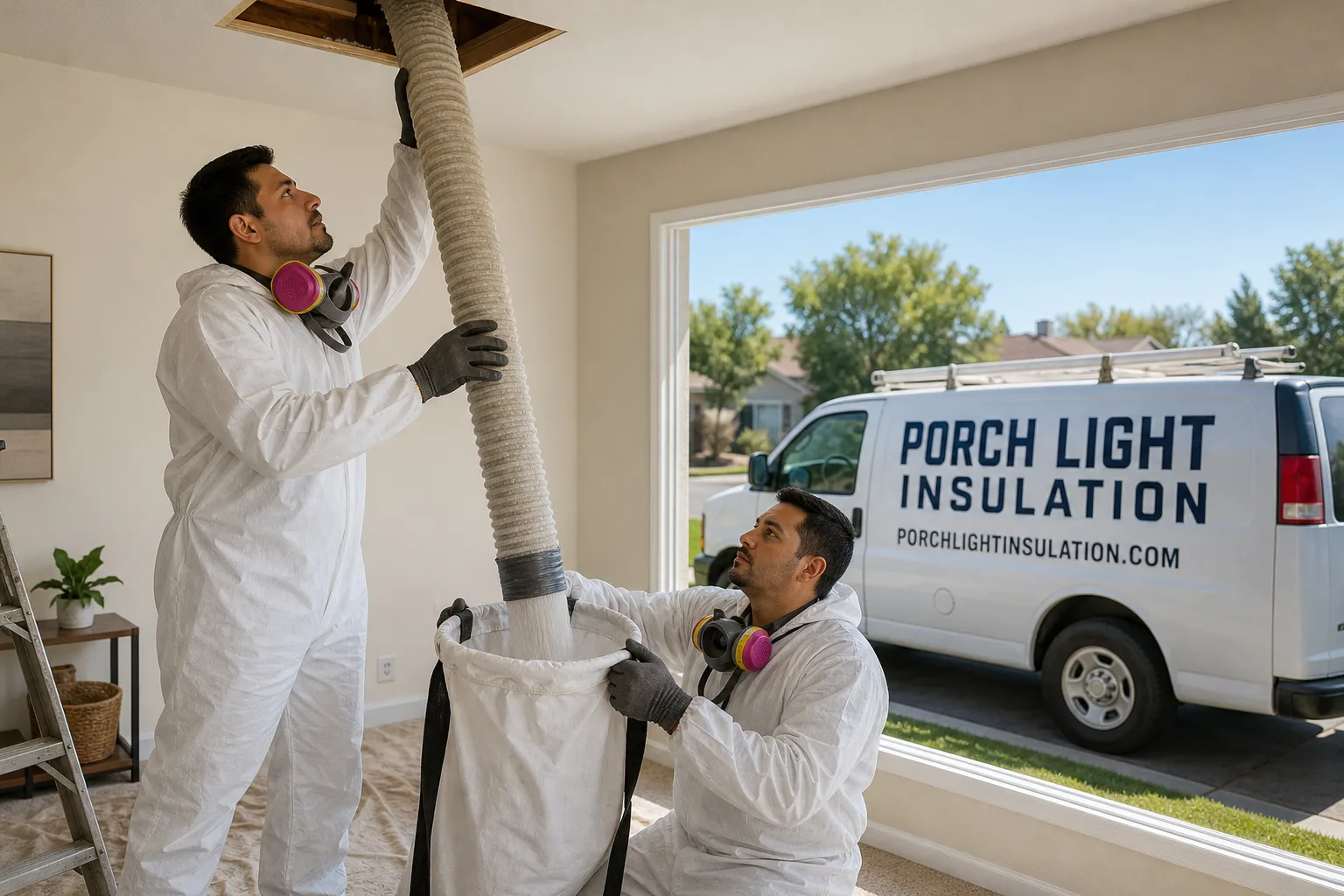
Spray Foam Insulation Contractors in Universal City operate under constraints you won’t find three miles away in Burbank. The work happens in occupied production facilities, behind security checkpoints, and often after hours. You need a contractor who understands access windows, badging requirements, and noise restrictions on an active lot. Porch Light handles this routinely. We schedule air sealing and insulation work around production calendars, not the other way around.
On one backlot job, a 1970s metal-framed soundstage was letting tram and coaster noise bleed through walls that had degraded from decades of heat cycling. Our crew removed the failed material, sealed gaps that Santa Ana winds had widened with dust, and installed Icynene open-cell foam. The production team reported a measurable drop in ambient noise before the next shoot.
Closed-cell spray foam, for record, runs about $1.80 to $3.50 per board foot installed in Universal City commercial work. It’s the right call for flat-roofed buildings where heat gain from the Hollywood Hills sun is brutal, and for any assembly where you want roughly double the R-value per inch.
Working Around Production Schedules
Most backlot structures can’t be shut down for a week. We plan spray foam installation in phases: building B’s north wall gets done Tuesday night, the south wall Wednesday, and production never stops. It takes more coordination than a standard residential job, but this is Universal City. You expected that.
Retrofit vs. Restart
When original 1970s-80s insulation has failed, the question is always whether to remove and replace or spray right over it. Old fiberglass batts in metal-framed walls have often slumped and left voids at the top. Spraying over the top doesn’t fix those voids. In most cases, especially when acoustic performance matters, full removal is the better long-term fix. We’ll tell you when a cheap overlay will actually work, and when it won’t.
Trusted Brands We Service in Universal City
Porch Light Insulation installs products from eight manufacturers, but for Universal City work, the brands that get the most attention are Icynene, Demilec, and Owens Corning. Icynene open-cell foam is our go-to for acoustic isolation. Demilec closed-cell handles high-R-value and vapor-control needs on flat-roofed commercial buildings. Owens Corning materials come in where a proven spec package from an architect or engineer needs to be matched. Because we’re authorized across all these lines, we’re not steering you toward one product because it’s all we carry. We carry the full range, so we pick the material that fits the failure mode, the budget, and the building.
Common Spray Foam Insulation Problems We See in Universal City Homes
Most Universal City buildings aren’t homes, but the insulation problems here are consistent. Here are the failure modes our crews see most on the hill.
- Original 1970s-80s insulation reaching end of life: Decades of heat cycling inside metal-framed soundstages causes fiberglass to slump and degrade. The result is acoustic leaks that ruin takes, and straightening that out almost always means full removal and re-fill with spray foam.
- Santa Ana wind-driven dust intrusion: The winds blow fine dust into every gap in an aging wall assembly. Once dust coats a surface, spray foam won’t adhere properly. We spend a fair amount of time prepping surfaces that look clean but aren’t.
- Flat-roof heat gain on commercial buildings: The sun in Universal City is intense, sun-baked, and relentless on flat roofs. Roof decks overheat, and any foam under them degrades faster than it would in a pitched-roof setting. A radiant barrier or cool-roof underlayment is often the missing piece.
- Acoustic bleed through steel framing: Soundstages are metal for a reason, but those same steel members conduct sound like tuning forks. Only a continuous spray foam layer that fully encases framing stops the bleed. Partial fills don’t.
Pricing for Spray Foam Insulation in Universal City, CA
Open-cell spray foam in Universal City runs $1.40 to $2.25 per board foot installed. Closed-cell runs $1.80 to $3.50 per board foot. For a typical soundstage wall retrofit of around 1,500 square feet, expect to spend $7,000 to $14,000 depending on material choice, access complications, and whether failed material has to be removed first. Rim joist work in production office buildings runs $9 to $15 per linear foot, installed. Garage ceiling and roof deck applications vary widely because roof decking geometry differs building to building. We give line-item estimates, free, after we walk the building. Call (877) 521-4987 and we’ll get you firm numbers, not a range with fine print.
We Also Serve Cities Near Universal City
Porch Light Insulation also serves Studio City, North Hollywood, Hollywood, and West Hollywood. If you need Spray Foam Insulation elsewhere in the Valley or over the hill, our crews are scheduling consistently across the area. We’re based in Universal City, so most nearby work gets same-week attention. Call (877) 521-4987 to check our current schedule.
Serving Universal City, CA — Our Local Coverage Area
We’re based in the Universal City area and know this community well. Use the map below to see our service coverage — if you’re nearby, we can almost certainly help.
FAQs About Spray Foam Insulation in Universal City
Yes. Open-cell spray foam is the most effective insulation material for damping airborne noise like the tram tour, coaster sounds, and general backlot activity. It absorbs sound rather than reflecting it, and when installed as a continuous fill in wall cavities, it measurably drops ambient noise. If you’re managing a building along the tram route, this is the first fix we recommend. Call (877) 521-4987 for a consultation on your specific building.
Soundstages are metal-framed buildings, and metal expands and contracts dramatically with temperature changes. Universal City’s hot, dry summers push surface temperatures well over 100 degrees inside uninsulated wall assemblies, and decades of that thermal cycling causes fiberglass batts to slump, compress, and pull away from framing. The result is acoustic leaks. Spray foam, once fully cured, does not slump or settle, which is why it’s the replacement of choice on the backlot. Call (877) 521-4987 for an evaluation.
Closed-cell spray foam under the roof deck is the best insulation for flat-roofed commercial buildings in Universal City because it provides about R-6.5 per inch and also acts as a vapor barrier. Pairing it with a radiant barrier or cool-roof coating reduces heat gain from the intense sun exposure. The combination keeps interiors cooler and protects equipment from heat stress. We can quote both options so you can compare. Call (877) 521-4987 for specific pricing.
Most backlot structures fall under City of Los Angeles permitting rules, and spray foam insulation in existing commercial buildings generally requires a permit. Some production facilities have their own internal review processes on top of that. Porch Light can handle the permit application or work with your facilities team to navigate their process. The best first move is to call (877) 521-4987 and tell us which building you’re dealing with, and we’ll map out the next steps.
Spray foam seals gaps at the wall-to-slab junction, around windows, and at roof intersections, which are exactly the openings Santa Ana winds use to push dust inside. Open-cell foam expands to fill irregular cavities, cutting off those pathways. In older metal-framed buildings with decades of accumulated gaps, the improvement after sealing and filling is often immediate. Call (877) 521-4987 for a free assessment of your building’s dust and noise entry points.
Written by Gil Tanner, Owner at Porch Light Insulation, serving Universal City since our founding.