
Emergency Attic Insulation Near Me: What Universal City Homeowners Should Do First
If you’ve just discovered wet insulation, raccoon damage, or a sudden ceiling stain in your Universal City home, the first call is rarely an insulation contractor. It’s usually a roofer, a pest exclusion specialist, or an HVAC tech, because insulation damage is almost always a symptom, not the root cause. Fix the source first, then replace the insulation once. If you’d rather not sort through the sequence yourself, call us at (877) 521-4987 and we’ll help you triage it over the phone. Most emergency attic insulation situations in Universal City follow a predictable pattern, and knowing the right order of operations saves you thousands of dollars and keeps you from paying for the same repair twice.
Why “Emergency” Attic Insulation Usually Isn’t the Insulation’s Fault
Insulation doesn’t spontaneously fail. It sits in your attic, doing its job, until something external damages it: water, animals, fire, or mechanical disruption. In Universal City, where homes range from 1950s ranch-style builds near the old Norton Air Force Base footprint to newer construction up toward the hills, the failure modes vary by neighborhood and home age. What we consistently see is that homeowners call an insulation company first because the visible symptom is in the attic. That’s understandable, but it skips the actual problem.
Here’s the triage framework we walk homeowners through before we even schedule a site visit. It takes five minutes and usually saves a wasted service call:
- Water stains on ceilings, damp insulation, or musty odor after rain: First call is a roofing contractor. Wet insulation means water got in through the roof deck, a flashing point, or a vent boot. Until that’s sealed, new insulation will get wet again within weeks.
- Torn insulation, droppings, nesting material, or animal noises at dawn/dusk: First call is a pest exclusion specialist. Raccoons, squirrels, and roof rats all use Universal City attics. New insulation installed before entry points are sealed is expensive animal bedding. We’ve seen this happen more times than we can count.
- Suddenly high energy bills, hot or cold rooms, or visible gaps around ductwork after a storm: First call is an HVAC technician. High winds from Santa Ana events can yank flex ducts apart in unconditioned attics, spilling conditioned air into the void. Insulation can’t compensate for a disconnected duct run.
- Post-fire soot, fine gray dust, or a lingering smoke smell in the attic after nearby wildfires: This one’s trickier. It can be dormant ember damage hidden under the fiberglass surface layer. We cover this in the next section because Universal City’s Wildland-Urban Interface zone makes it a distinct local concern.
The point isn’t to chase you away from calling us. It’s to make sure the money you spend on insulation actually stays effective. We’d rather talk you through the right sequence than sell you a job that fails in six months.
Wet Insulation in Universal City Attics: The 24-48 Hour Clock
Wet attic insulation in Universal City needs removal within 24 to 48 hours of the water intrusion. Not because the insulation itself is ruined beyond that window, but because the roof decking beneath it starts growing mold that fast in our climate. Universal City’s summer attic temperatures regularly exceed 130°F, and when you add moisture, you’ve created a mold incubator that works faster than most homeowners expect. By day three or four, you’re not just replacing insulation. You’re potentially replacing or remediating plywood sheathing, which triples the project cost.
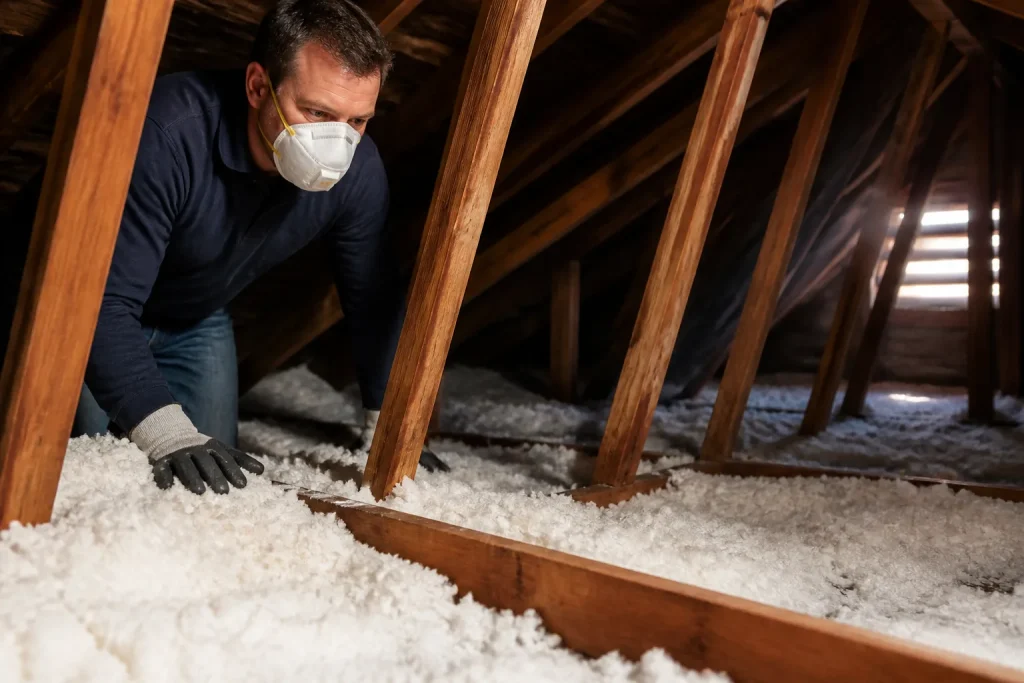
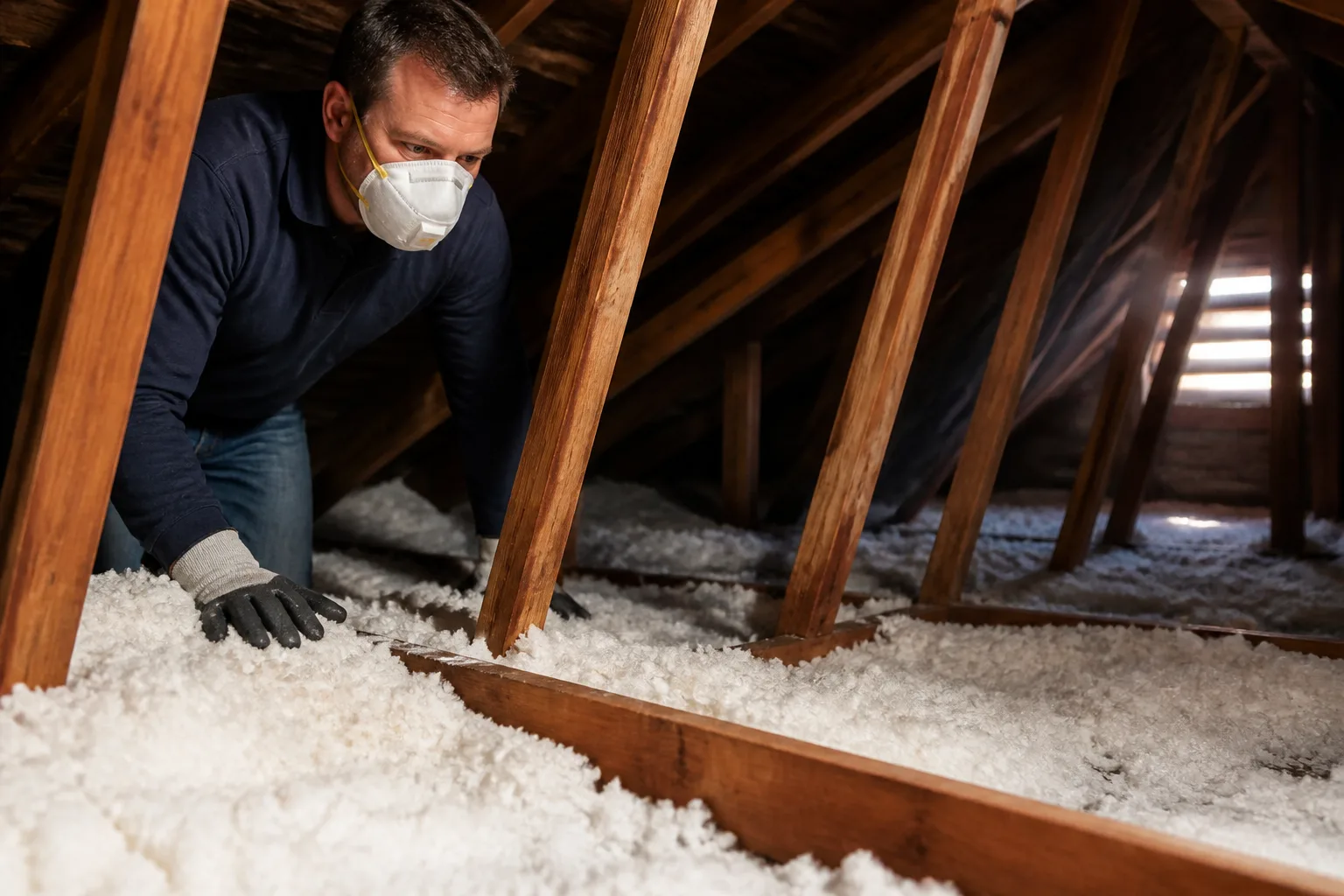
Here’s what wet insulation actually looks and smells like, in case you’re checking your attic right now:
- Loose-fill fiberglass or cellulose: Clumps and mats down instead of sitting fluffy. You’ll see dark gray or brown staining where water wicked through. It smells like damp cardboard or wet leaves.
- Fiberglass batts: The kraft paper facing delaminates or develops black speckling. Batts feel heavy and sag between joists. The smell is musty, like an old basement.
- Spray foam: Closed-cell foam doesn’t absorb water the way fiberglass does, but open-cell foam does soak it up. You’ll see discoloration, and if the water sat long enough, the foam can separate from the decking and need cutting out.
Before you touch anything, document everything for your insurance claim. Take photos from multiple angles. Photograph the roof deck, the insulation surface, any standing water, and the ceiling below. Do not bag up and remove the damaged material before your adjuster sees it unless a contractor has advised you to mitigate active mold growth, because in some cases removal before documentation can complicate a claim. Most Universal City homeowner policies cover sudden water damage to insulation, but adjusters want evidence of the original condition.
One thing we’ve seen repeatedly: homeowners replace wet insulation without fixing the roof first because the roofer told them the leak is “minor” or “hard to find.” That’s a recipe for paying twice. Always sequence roof repair before insulation replacement, even if it means waiting another week.
The Universal City Wildfire Factor: Ember Intrusion in the WUI Zone
Universal City sits within or adjacent to Wildland-Urban Interface zones, which changes how you should think about attic insulation after fire season. Even when a fire doesn’t reach your neighborhood directly, the ember showers from distant burns can lodge in attic vents, soffit gaps, or ridge caps and smolder inside for hours before igniting or, more commonly, burning out without visible flame damage from the interior. The result is insulation that looks fine on top but has charring or heat-compromised material underneath, especially near eave edges and vent openings.
We learned to look for this after the fire seasons of recent years. A Universal City homeowner may open the attic hatch, glance at the surface of the insulation, and see nothing alarming. But when we pull back the top layer near the eave vents, we sometimes find the vapor control face of the batt has been heat-shrunk or degraded, or the fiberglass itself has turned brittle and gold-brown from direct ember contact. That compromised layer no longer performs correctly. It may also have allowed smoke particulates to deposit deep in the fiber matrix, which is why some homes smell like campfire months after the fires have passed.
What to do if you’ve lived through a nearby fire and you’re not sure your attic is safe:
- Do a visual check from the access hatch with a bright flashlight. Look at the insulation surface near eaves, vents, and any gaps in the decking.
- If you see any dark speckling, crusting, or areas where the insulation looks melted or pressed flat specifically near vent openings, call a licensed professional for a closer look. Do not just fluff it back up and assume it’s fine.
- Ask whether testing for smoke residue makes sense for your situation. Some insurance claims cover post-fire attic cleaning and insulation replacement even without visible structural damage, but the burden of proof is on documentation.
This is a situation where the material choice matters going forward. If you’re re-insulating after an ember event, we often recommend spray foam insulation in Universal City using Icynene or Demilec products, because closed-cell foam adds an air-sealing layer at the decking that reduces the pathways where embers and smoke can sneak in around vent penetrations. Or for homeowners who prefer batt systems, mineral wool from Rockwool carries a higher temperature tolerance and distinct fire-resistance properties compared to standard fiberglass. Either way, the insulation choice should be informed by the fire history on your specific street, not just a generic R-value chart.
What a Legitimate Emergency Insulation Response Actually Includes
When you do reach the point where insulation work is the right next step, you should know what a real emergency response looks like in Universal City. Some contractors use urgency as a sales lever: “This is a serious health hazard, we need to get a crew out today, here’s the big number, sign here.” A legitimate response is fast but never skips the diagnostic step. It includes these four things:
- Same-day or next-day assessment: An actual site visit, not a phone quote. The technician goes into the attic, takes readings, and documents the condition. No one can give you a real price for emergency attic insulation work without seeing the space.
- Written scope before any material goes in: You get a plain-language explanation of what’s being removed, what’s being installed, what R-value is being achieved, and what the total price is. Not a verbal handshake and a truck that shows up with “a bunch of insulation.”
- Clear communication about co-trade sequencing: If the roof isn’t fixed, the contractor tells you the insulation work is on pause until it is. If pest entry points aren’t sealed, same answer. A contractor who’s willing to install over an unfixed problem is prioritizing their invoice over your outcome.
- Removal and disposal included: Emergency attic work usually means taking out damaged material. That’s messy, hot, dirty work and it’s a distinct line item. If a quote seems suspiciously low, ask whether removal and disposal are actually in the number.
On the last point about urgency as a sales tactic: we’ve been called into Universal City attics where a previous contractor told the homeowner they needed full removal and replacement of all insulation in the house because of one wet corner. In most cases, spot remediation of the damaged area plus targeted air sealing around the leak source is sufficient. Full removal makes sense when there’s widespread mold, fire damage, or animal contamination throughout the space. It doesn’t make sense when one corner of the attic got wet and the rest of the material is dry and intact. A good contractor differentiates between those situations and explains why. If someone insists on full removal without showing you the damage, get a second opinion before spending $7,000 or more.
Related services we handle in Universal City: attic insulation, spray foam insulation, and blown-in insulation. The method depends on your home’s construction, the condition of the existing material, and your performance goals.
What happens when you call
- 1
A real person answersNo phone trees — you reach a local pro.
- 2
You get an upfront price rangeHonest numbers before anyone is dispatched.
- 3
A background-checked tech heads outLicensed & insured, dispatched right away.
- 4
You approve before work beginsNothing starts until you say go.
Universal City Homes We’ve Worked On and What They Teach Us
We’ve pulled some interesting things out of Universal City attics over the years, and the pattern is usually the same: the homeowner thought the insulation itself failed, when what actually happened was an unsealed chase, a disconnected vent, or an animal that found a 4-inch gap and took it as an invitation. One attic near the hills had raccoons nesting in blown-in fiberglass for what the staining pattern suggested was an entire winter. The insulation was matted, urine-damaged, and completely ineffective. But the real cost driver wasn’t the insulation. It was the four entry points the pest company found around the roofline and the soffit returns. Once those were sealed, the replacement material we installed actually stayed in good shape.
This is why we emphasize the sequence so hard. Insulation is a passive system. It rewards a tight envelope and punishes sloppy sequencing. A house with a sealed roof, sealed penetrations, and properly ventilated soffits will hold its insulation performance for decades. A house where the insulation is installed before the envelope is tight will eat insulation like a rental car eats tires.
When to call a pro, honestly: if you’ve confirmed the source of the damage is handled and you’re looking at replacing the affected material, or if you’re not sure whether the source is actually handled and want a second pair of eyes on the attic, that’s when we’re the right call. We’ll tell you if the insulation is even due for replacement or if it can be spot-fixed. We’ll also tell you if the real problem is a venting issue that insulation can’t solve. Insulation is all we do, which means it’s all we’ve mastered. That single-trade focus matters when you’re making a decision right after a stressful event because you get a clear recommendation rather than a bundled sales pitch that includes a roof, a new HVAC, and a bathroom remodel you didn’t ask for.
The Bottom Line
Emergency attic insulation near you in Universal City is almost always a downstream symptom. Wet insulation means a roof leak. Animal damage means pest entry. Soaring energy bills after a storm could mean duct separation. Post-fire attic issues mean ember intrusion or smoke contamination. The correct sequence is: identify the source, fix the source, document everything, then replace only what actually needs replacing. Skipping to insulation replacement feels productive but often means doing the job twice and paying for it twice.
If you’re in Universal City and need help figuring out what you’re actually dealing with, call Porch Light Insulation at (877) 521-4987. We offer free estimates, we’ll walk the attic with you, we’ll explain what we see in plain English, and if the real problem is a roofer or a pest company, we’ll tell you to call them first. Then we’ll be here when the attic is ready for us.
Frequently Asked Questions
Most emergency attic insulation replacement jobs in Universal City run between $1,500 and $4,500 depending on the size of the affected area, the material chosen, and whether removal and disposal of the damaged material is included. Spot remediation of a small wet corner may run $600 to $1,200, while full attic replacement after animal damage can exceed $6,000. Call (877) 521-4987 for an exact quote based on your attic. Estimates are free.
We schedule same-day or next-day assessments for true emergencies throughout Universal City whenever our schedule allows. A true emergency is water actively leaking into the attic, visible mold growth, or animal activity that needs to be addressed before the insulation can be assessed. Call (877) 521-4987 as early in the day as possible and we’ll do our best to get someone to you the same day.
It depends on the extent of the water damage. If the wet area is confined to a small section, spot repair and targeted drying is usually cheaper than full replacement. If water saturated a large area and sat for more than 48 hours, the risk of mold in the decking usually means broader removal is the safer financial choice in the long run. Universal City’s hot attic temperatures accelerate mold growth, so we lean toward removal when the exposure window is uncertain or the daylight seams in the decking show staining.
Most Universal City homeowners policies cover attic insulation replacement when the damage results from a sudden, covered event like a storm-created roof leak or a fallen tree. Animal damage and gradual wear are typically not covered unless you have specific riders. Document the damage with photos before removing anything, and call (877) 521-4987 if you need a contractor’s assessment to support your claim. We work with insurance documentation regularly and can help you build the file.
Written by the team at Porch Light Insulation, serving Universal City since 2014.
Need Insulation Help?
Call Porch Light Insulation — licensed & insured, here with fast after-hours help in Universal City.
(877) 521-4987