
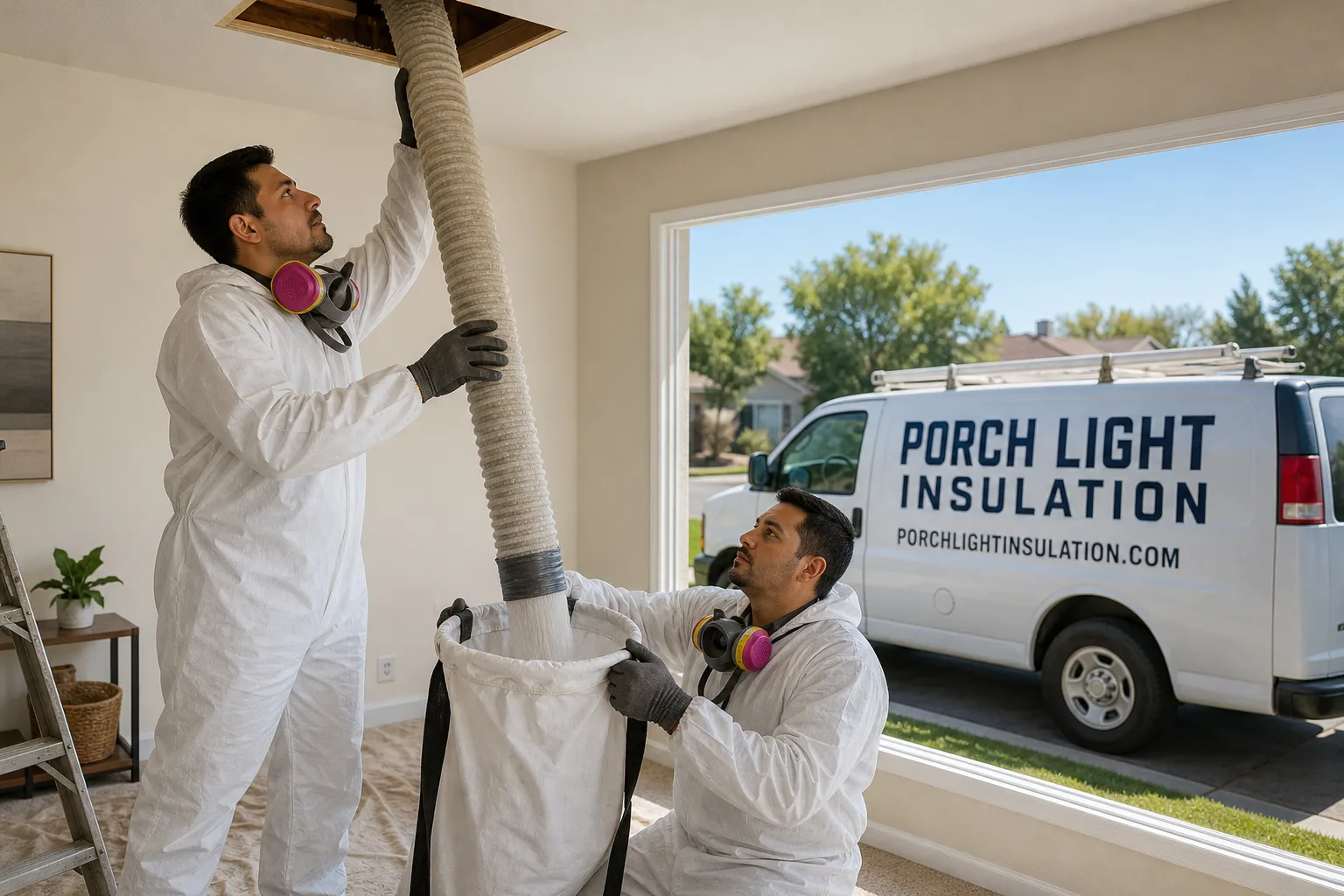
Fast, Reliable Spray Foam Insulation Across Rolling Hills Estates
Spray foam insulation in Rolling Hills Estates generally costs $3.50 – $7.50 per square foot installed, with most attic projects on the Peninsula landing between $6,000 and $18,000 depending on cavity depth and whether you’re sealing open-beamed vaults or standard attics. We get calls from Rolling Hills Estates homeowners every week about fog-damp rooms, cold vaulted ceilings, and attics where 1960s batts have simply given up on the downhill side. Porch Light Insulation has worked on enough canyon-edge homes along Palos Verdes Drive East and near Rolling Hills Country Club to know exactly how marine air behaves once it gets inside your roofline. Call (877) 521-4987 for an estimate that accounts for your specific slope, your specific attic, and nothing else.
Why Porch Light Insulation Is Rolling Hills Estates’s Preferred Spray Foam Insulation Company
Homeowners in Rolling Hills Estates keep calling us because our estimators show up already understanding the Peninsula’s microclimates. We don’t give you a generic “attic needs more R-value” answer. We climb up, check which side of your roofline faces the ocean air, and recommend materials accordingly. Gil Tanner founded Porch Light with one rule: insulation is all we do, which means it’s all we’ve mastered. No roofing side work, no HVAC add-ons. Just insulation, every day, across Rolling Hills Estates and the South Bay.
That focus shows up in our product bench too. We’re authorized to install spray foam from Icynene and Demilec, plus fiberglass, mineral wool, and loose-fill from Owens Corning, Johns Manville, Knauf, Rockwool, CertainTeed, and GreenFiber. Eight manufacturers, one goal: the right fit for your specific situation. If your Rolling Hills Estates attic needs moisture-resistant closed-cell on the fog side and open-cell on the sheltered side, we’ll spec that. If your budget points toward blown-in, we’ll tell you honestly instead of steering you toward the highest-margin foam.
Response time to Rolling Hills Estates is usually same-week for estimates, and we schedule full installs within a few days of approval. The Palos Verdes Peninsula isn’t a far drive, but we send crews who know the roads, know the parking constraints on hillside lots, and know how to work clean around landscaping that homeowners have spent decades building.
Spray Foam Attic Insulation in Rolling Hills Estates
Spray Foam Attic Insulation in Rolling Hills Estates is the most common fix we recommend for canyon-edge homes where marine air pushes through vents and undercuts whatever insulation used to be there. The job involves removing failed legacy batts, sealing the attic’s air leaks, and applying foam directly to the roofline or attic floor depending on whether your attic is vented or unvented. In Rolling Hills Estates specifically, this almost always means paying attention to the downhill slope about twice as much as the uphill side. Open-cell foam in an attic here typically installs at $3.50 – $5.50 per square foot; closed-cell runs $5.50 – $7.50. A typical 1,200-square-foot attic in Rolling Hills Estates lands around $8,000 – $14,000 all in.
Open-Cell Spray Foam for Vented Attics
Open-cell foam expands to fill tricky cavities and seals air movement while letting moisture pass through. That matters on the Peninsula because attics here run damp. In a vented Rolling Hills Estates attic, open-cell on the roofline can stop the fog-driven drafts that work batts loose while still allowing the roof deck to dry toward the vents.
Closed-Cell Spray Foam on Exposed Canyon Slopes
Closed-cell is denser, acts as a vapor barrier, and adds structural rigidity. On the exposed downhill side of a Rolling Hills Estates roofline, where ocean air hits the deck and condenses, closed-cell often makes more sense than open-cell. It blocks that moisture outright instead of managing it. We use Demilec closed-cell foam on some of the wettest canyon-edge applications we see.
Spray Foam Wall Insulation in Rolling Hills Estates
Spray Foam Wall Insulation in Rolling Hills Estates tends to center on two specific problems: uninsulated kneewalls from 1970s and 1980s additions, and exterior walls where original batts have slumped or compacted inside shiplap or board-and-batten construction. The job involves either drilling and injecting foam into existing wall cavities, or opening small access points to reach kneewall cavities that were sealed off during a remodel. Wall foam in Rolling Hills Estates runs $3.00 – $5.50 per square foot for injection and $15 – $30 per square foot for full cavity fill where access is straightforward. Kneewall jobs often come in under $2,500 because the cavity is shallow and accessible.
Kneewall Sealing for Remodeled Additions
Additions built onto 1960s Rolling Hills Estates homes frequently leave the kneewall between the original roofline and the new room completely bare. The new room feels freezing, and condensation shows up as must. We open the kneewall from one side, seal it with foam, and close it back so the room finally holds temperature.
Exterior Wall Injection Without Demolition
If your original walls are hollow or have batt cavities that have settled, drilling small access holes and injecting foam is far less disruptive than tearing out drywall. We’ve done this on homes near Rolling Hills Road where homeowners wanted to preserve vintage plaster and original millwork. The foam fills the cavity, stops the draft, and the holes patch clean.
Trusted Brands We Service in Rolling Hills Estates
We carry spray foam from Icynene and Demilec, and we pair them with supporting products from Owens Corning, Johns Manville, and GreenFiber where the job calls for hybrid approaches. What that means for Rolling Hills Estates homeowners is we aren’t tied to one manufacturer’s spec sheet. We match the material to your home, not to our inventory. If your attic needs Demilec on the wet side and GreenFiber loose-fill over the flat sections, that’s what gets installed. Fast turnaround matters too; our suppliers stock what we need within a day or two, so Rolling Hills Estates projects don’t stall waiting on material.
Common Spray Foam Insulation Problems We See in Rolling Hills Estates Homes
- Fallen batts on the downhill slope. Fog-driven drafts push through canyon-edge attic vents and physically work 1950s – 1970s fiberglass batts loose. The downhill ceiling plane ends up with bare spots the homeowner can’t see from the attic hatch.
- Condensation on vaulted and open-beamed ceilings. These custom homes have irregular cavities where old batts were stuffed in with no air barrier. Moist marine air hits the cold side, condenses, and the homeowner blames the fog when really it’s an air-sealing problem.
- Uninsulated kneewalls from remodels. So many Rolling Hills Estates additions left kneewall cavities empty. Those rooms run cold, and the temperature difference between the original house and the addition drives condensation and complaints.
- Wind-washing through ridge and eave vents. The peninsula’s persistent onshore breeze moves through attic vents like a slow fan. Even decent insulation gets undermined when air moves across its surface, which is why air sealing matters as much as R-value here.
Pricing for Spray Foam Insulation in Rolling Hills Estates, CA
Open-cell spray foam in Rolling Hills Estates runs $3.50 – $5.50 per square foot of applied area. Closed-cell runs $5.50 – $7.50 per square foot. A full attic with open-cell on a 2,000-square-foot home typically lands between $9,000 and $16,000. Kneewall-only jobs are often $1,800 – $3,200. Wall injection ranges from $3.00 – $5.50 per square foot depending on cavity depth and access. What shifts the number on a Rolling Hills Estates home: slope exposure, how much legacy insulation has to be removed, whether the attic is vented or unvented, and whether vaulted ceilings require scaffold work. Call (877) 521-4987 and we’ll give you a fixed quote before any work starts. Estimates are free.
We Also Serve Cities Near Rolling Hills Estates
Our Spray Foam Insulation crews cover the whole Palos Verdes Peninsula and the South Bay. If you’re in Rolling Hills Estates, we’re also close by in Manhattan Beach, Torrance, Lomita, and Palos Verdes Estates. Same familiar marine layer, same canyon-edge building stock, same crew standards across every job.
Serving Rolling Hills Estates, CA — Our Local Coverage Area
We’re based in the Rolling Hills Estates area and know this community well. Use the map below to see our service coverage — if you’re nearby, we can almost certainly help.
FAQs About Spray Foam Insulation in Rolling Hills Estates
On canyon-edge streets, the downhill side of your attic is exposed to ocean-air vents and fog-driven drafts that physically push through and work batts loose, while the sheltered uphill cavity stays dry and untouched. That’s a wind-washing problem, not an age problem. The fix is air sealing plus foam that stays put, not simply replacing batts that will fall again. Call (877) 521-4987 and we’ll inspect which side of your roofline is doing what.
Yes, spray foam can be installed against the roofline from the attic side, leaving your open beams fully visible from below. The beams stay exposed, the ridge view stays intact, and the foam does its work behind the ceiling plane. We’ve done this on homes across 90505 where the owner didn’t want to lose the architectural character of the vaulted spaces. It takes careful masking and crew experience, which is exactly what we bring.
Yes, in Rolling Hills Estates moisture resistance usually matters more than extreme temperature performance. The marine layer keeps the Peninsula cooler than inland LA, but persistently damp air will condense on cold surfaces if the air seal isn’t right. Closed-cell foam acts as a vapor barrier on exposed slopes, and that’s often the better call here than chasing a higher R-value with the wrong material. We’ll look at your specific roofline and spec accordingly.
The kneewall was almost certainly never insulated when the addition was built. It’s an extremely common find in Rolling Hills Estates remodels from the 1970s and 1980s. The cavity sits empty, outside air moves through it, and the room on the other side can’t hold heat. The fix is sealing that cavity with spray foam, which we can usually do from one side in a single day. Most kneewall jobs in Rolling Hills Estates run $1,800 – $3,200.
For most Rolling Hills Estates homes with original batts, especially on the downhill slope, spray foam is worth it because it solves the air-sealing problem that batts can’t. New batts will eventually work loose again if the fog-driven drafts aren’t addressed. Foam seals the air path and insulates in one pass. If budget is tight, a hybrid approach, open-cell on the roofline plus blown-in coverage on flat sections, often makes sense. We’ll quote both options side by side so you can see the real difference in cost and performance.
Written by Gil Tanner, Owner at Porch Light Insulation, serving Rolling Hills Estates and the Palos Verdes Peninsula.
Ready to stop fighting the fog? Call (877) 521-4987 for a free spray foam insulation estimate in Rolling Hills Estates. We’ll climb your attic, tell you what’s actually happening up there, and give you a fixed number before any work begins.