
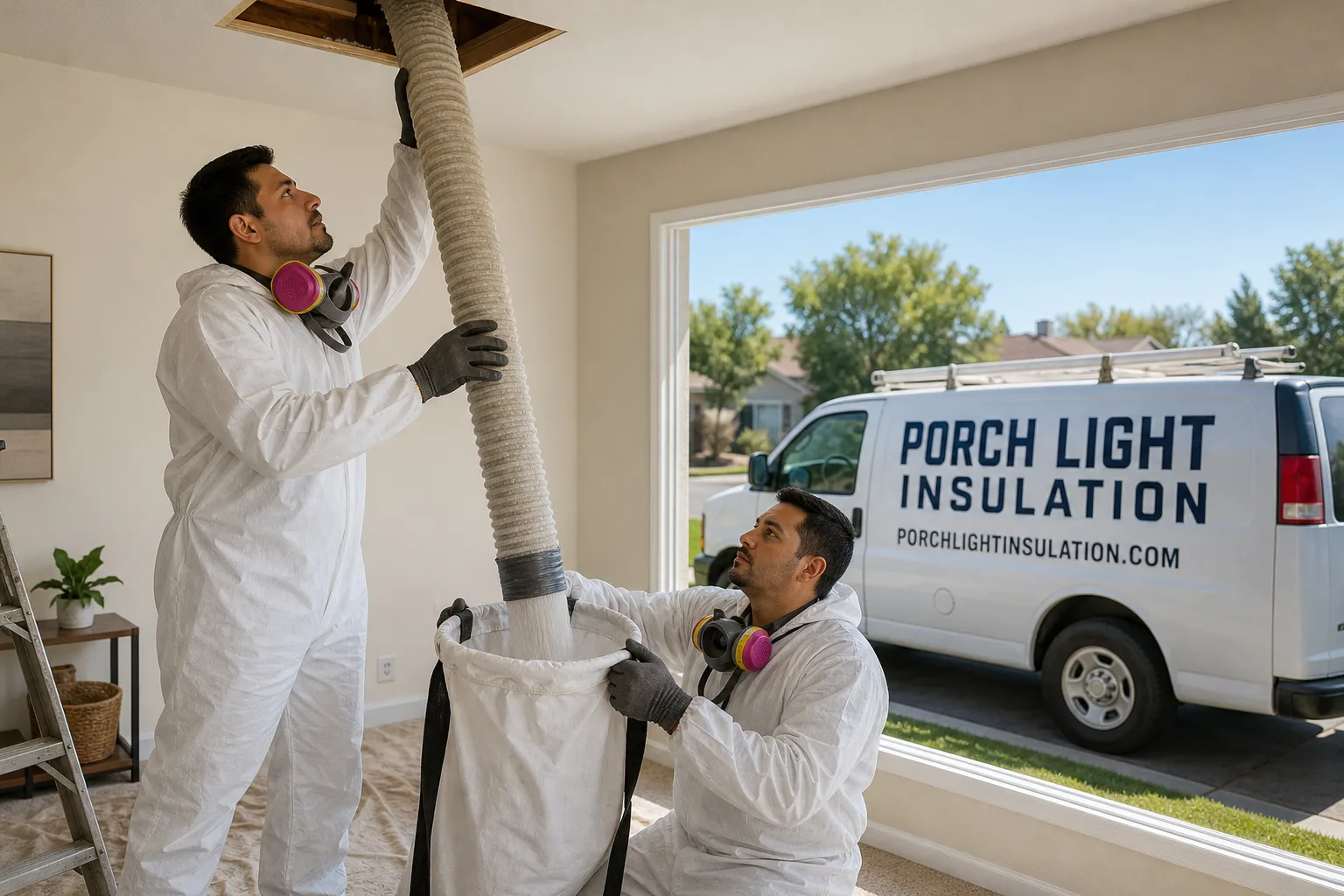
Fast, Reliable Spray Foam Insulation Across North Hollywood
Spray foam insulation in North Hollywood typically costs $2.50 to $6.50 per square foot installed, with most attic and wall retrofit jobs landing between $3,200 and $12,000 depending on access, roof type, and cavity depth. Our crews reach most North Hollywood addresses within 24 to 48 hours, and we carry both open-cell Icynene and closed-cell Demilec on every truck. If you’re dealing with a flat-roof garden apartment off Victory or a single-wall bungalow near the Arts District that bakes by mid-afternoon, call (877) 521-4987 and we’ll walk through what’s actually going on before anyone quotes a number.
Porch Light Insulation has been foaming attics, walls, and roof decks across the 91601, 91605, 91606, 91615, and 91616 ZIP codes long enough to know that North Hollywood’s housing stock throws curveballs that a generic insulation crew never sees coming. The flat roofs, the sealed soffits, the converted garages, the knob-and-tube-era framing: we’ve foamed around all of it. That’s why our Spray Foam Insulation team starts every North Hollywood quote by asking about roof access, not R-value.
Key takeaways for North Hollywood homeowners:
- Flat-roof 1960s – 70s apartments along Victory and Lankershim usually need the roof deck foamed, not the attic – because there often isn’t an attic.
- Single-wall bungalows in the Arts District need thin-cavity foam applied differently than a standard 2×4 wall.
- Closed-cell foam on the underside of a flat roof deck doubles as an air seal and a traffic-noise barrier near the Red Line and Burbank/Chandler truck corridors.
- We carry open-cell and closed-cell options from Icynene and Demilec so no one has to settle for whatever’s on the truck.
Why Porch Light Insulation Is North Hollywood’s Preferred Spray Foam Insulation Company
Insulation is the only trade we practice. That means the estimator who shows up at your North Hollywood door knows what a closed-cell lift looks like on a sealed-soffit flat roof, not just what a blank insulation bid looks like. We’re authorized to install products from Owens Corning, Johns Manville, Knauf, Rockwool, CertainTeed, Icynene, Demilec, and GreenFiber – eight manufacturers, one goal: the right material for your specific situation, not the one that happens to be in stock.
Our crews work North Hollywood every week. We know the difference between a 1920s single-wall bungalow off Magnolia and a 1970s four-plex on Vineland, and we know which one is going to need roof-deck access cut from a closet ceiling. Homeowners across the Arts District, Valley Glen, and the Victory corridor have trusted us with their foam work because we explain the access problem, the moisture risk, and the noise-blocking upside before we ever talk price. Gil Tanner, our owner, insists on that order of operations: diagnose first, bid second.
We match the material to your home, not to our inventory. If your North Hollywood attic hits 105°F by 3pm and you’ve got a flat roof with no venting, you need a specific approach. If you’re two blocks from the Red Line and the rumble comes through the ceiling, that’s a different foam, a different thickness. Same quote sheet, same call: (877) 521-4987.
Spray Foam Attic Insulation in North Hollywood
Spray Foam Attic Insulation in North Hollywood is where most of our flat-roof work starts: a 1960s or ’70s garden apartment with a sealed soffit, no walkable attic, and a ceiling that bakes by late afternoon. The first question is whether there’s an access hatch at all. On a four-plex off Chandler near the Red Line corridor, our crew found the unit’s “attic” was a sealed low-slope roof cavity with no hatch, so we cut access from a closet ceiling and foamed the underside of the roof deck rather than trying to blow anything into a space no one could stand in. Two doors down, a 1940s single-wall bungalow had a converted-garage “attic” that had to be foamed as a wall cavity, not a ceiling. In both cases, closing the uncontrolled air paths cut the diesel and rail rumble coming off Chandler and Lankershim as much as it changed the measured R-value.
Attic foam in North Hollywood runs $2,800 to $9,500 for a typical flat-roof retrofit, with the wide range driven by access difficulty, roof deck condition, and whether we’re foaming the deck itself or the top of a wall cavity. Closed-cell Demilec is our default on flat roof decks because it adds structural rigidity and blocks moisture, while open-cell Icynene works well in vented attics where sound control matters more than vapor control. For a no-access flat roof, expect to add $600 to $1,400 for cutting and framing an access hatch.
Flat Roof Deck Foaming
On sealed-soffit flat roofs, there’s no vent path. Hot Valley attic air has nowhere to go, so any foam applied over a wet or unvented deck traps moisture against the stucco. We inspect for trapped moisture first, and we apply closed-cell foam directly to the underside of the roof deck so the foam becomes the air barrier and the thermal boundary at the same time. That’s the only way to handle a 91605-style flat roof without turning it into a mold sandwich.
Hot Attic Ceilings Above Garden Apartments
North Hollywood’s inland Valley microclimate means summer highs over 100°F. In a 1970s apartment with zero insulation and a flat roof, the ceiling surface can exceed 120°F by 3pm. Foaming the roof deck drops that surface temperature by 25 to 40 degrees and cuts cooling demand in the hottest months. For tenants and landlords in the Victory/Vineland corridor, that’s the difference between a unit that’s tolerable in August and one that isn’t.
Spray Foam Wall Insulation in North Hollywood
Spray Foam Wall Insulation in North Hollywood usually means retrofitting a single-wall or thin-wall bungalow from the 1920s – 1940s around the Arts District and the 91601 flats. These homes were built with no true cavity depth, original single-pane aluminum windows, and knob-and-tube-era framing. A crew that sprays a thin wall as if it’s a standard 2×4 cavity ends up with uneven thickness, gaps at the framing, and foam that doesn’t adhere well to old plaster. We treat every thin-wall bungalow as its own project: we probe the actual cavity, map the framing, and shoot foam in lifts sized for whatever space actually exists.
Wall foam on a single-wall North Hollywood bungalow runs $4.50 to $7.00 per square foot of wall area, with most whole-house retrofits landing between $5,500 and $14,000. The price is driven by the fact that access often means removing stucco or plaster in sections, and because the old framing leaves irregular cavities. For units closer to the Red Line or the Burbank/Chandler truck route, closed-cell Demilec adds meaningful airborne-noise reduction, which matters as much to our Arts District customers as the R-value does.
Thin-Wall Cavity Application
We don’t spray thin walls blind. Our crews map the framing with a stud finder and borescope before the first pass, because a 1920s bungalow off Magnolia has framing spacing and depth that no two builders ever matched. The foam goes in controlled lifts so it cures evenly without bowing the plaster. Gaps at the knob-and-tube-era framing get hand-sealed after the main pass.
Converted Garage “Attics” and Blind Cavities
That “attic” above a converted garage off Chandler? It’s often just a sloped ceiling over an old garage wall. We treat it as a wall cavity, not an attic, because the thermal boundary is the sloped plane, not a horizontal ceiling. Foaming those converted-garage assemblies correctly is one of the highest-impact retrofits in North Hollywood, because it’s usually the leakiest, noisiest, hottest room in the house.
Trusted Brands We Service in North Hollywood
We’re authorized to install products from eight manufacturers, and for North Hollywood work we lean on three: Icynene for open-cell sound control in vented attics, Demilec for closed-cell on flat roof decks and thin walls, and Owens Corning for comparison quotes where fiberglass or mineral wool makes more sense. Because our North Hollywood customers call about everything from Arts District bungalows to Victory corridor four-plexes, we stock local parts and keep both open-cell and closed-cell foam on hand for fast same-week turnaround. No waiting on a distributor truck from the Inland Empire when your flat roof is cooking and the tenant is calling.
Common Spray Foam Insulation Problems We See in North Hollywood Homes
- Sealed-soffit flat roofs with no vent path. The 1960s – 70s garden apartments along Victory and Lankershim were built with sealed soffits and no attic decking. Hot Valley air has nowhere to go, and foam applied over a wet deck traps moisture against the stucco. We inspect for trapped moisture before any roof-deck foam goes in.
- Single-wall bungalows with no true cavity depth. Arts District homes from the 1920s – 1940s have walls so thin that a standard 2×4 spray pass leaves uneven thickness and gaps at the framing. We probe the actual cavity and shoot controlled lifts sized to the space, then hand-seal gaps at the old knob-and-tube framing.
- Converted garages and flat roofs with no access hatch. The worst-performing ceiling in North Hollywood is often the one nobody can reach. We cut access from closet ceilings or foamed the underside of roof decks from a ladder or crawl space, because leaving it untreated is the default and the default is why the room cooks.
- Freeway, rail, and truck noise through the roof assembly. The Red Line corridor and the Chandler/Lankershim truck traffic put diesel and rail rumble right through thin roof decks and single walls. Closed-cell foam doubles as an air seal and a sound barrier; in two blocks off Chandler we’ve had customers tell us the rumble dropped more than they expected from any R-value number.
Pricing for Spray Foam Insulation in North Hollywood, CA
A typical flat-roof attic retrofit in North Hollywood runs $2,800 to $9,500. A thin-wall single-wall bungalow retrofit lands between $5,500 and $14,000. The spread comes down to three things: access (cutting a hatch into a sealed soffit adds real labor), cavity depth (a 1940s bungalow is not a 1990s tract home), and material choice (closed-cell Demilec runs about 40% more per board foot than open-cell Icynene but adds vapor control and structural rigidity). Rim joist foam in a crawl space off Victory usually runs $900 to $2,400. Garage ceiling foam over a converted garage runs $1,800 to $4,500. Every estimate is free, and we never quote a number without looking at the roof access first. Call (877) 521-4987.
We Also Serve Cities Near North Hollywood
Our crews cover the neighborhoods around North Hollywood every week, including Studio City, Universal City, Burbank, and Valley Glen. If you’re on the edge of the 91601 ZIP or just over the line into the 91605 corridor, the same crew and the same foam options apply. We keep our route scheduling tight so a Valley Glen four-plex gets the same week turnaround as an Arts District bungalow. Call (877) 521-4987 and tell us your street – we’ll tell you when we can be there.
Serving North Hollywood, CA — Our Local Coverage Area
We’re based in the North Hollywood area and know this community well. Use the map below to see our service coverage — if you’re nearby, we can almost certainly help.
FAQs About Spray Foam Insulation in North Hollywood
Yes. We cut an access hatch from a closet ceiling or another interior location, inspect for trapped moisture in the roof assembly, and foam the underside of the roof deck directly. This is the standard approach for North Hollywood’s sealed-soffit flat roofs. Call (877) 521-4987 for a free access assessment – we’ll tell you exactly where the hatch goes and what the roof deck looks like before we quote.
Yes, measurably. Closed-cell Demilec foam in a thin-wall bungalow adds meaningful airborne-noise reduction through the wall and roof assemblies. Customers two blocks from the Chandler/Lankershim corridor report the Red Line and truck rumble drops noticeably, not just the temperature swing. The noise reduction comes from closing air paths, not from foam’s mass.
For a flat-roof garden apartment in the 91605 corridor, we target R-30 to R-38 with closed-cell foam on the roof deck. That’s enough to drop ceiling surface temperatures 25 to 40 degrees in August. For vented attics with open-cell foam, R-38 to R-49 is the working range. The right number depends on roof type and access, not on a generic chart.
Closed-cell Demilec, almost always. Flat roof decks need the vapor control and structural rigidity that closed-cell provides, plus the air seal keeps moist Valley air from condensing against the stucco. Open-cell Icynene works in vented attics where sound control matters more than vapor control, but on flat decks closed-cell is the standard.
It’s treated as a wall cavity, because the thermal boundary is the sloped plane over the old garage, not a horizontal ceiling. We foam the sloped assembly in controlled lifts and seal the air paths the same way we’d do a thin wall. That converted-garage ceiling is usually the leakiest, noisiest room in the house, and it’s the one most North Hollywood crews skip because it’s awkward to reach.
Written by Gil Tanner, Owner at Porch Light Insulation, serving North Hollywood since day one.